
Here is another nice puzzle I saw on brilliant.org
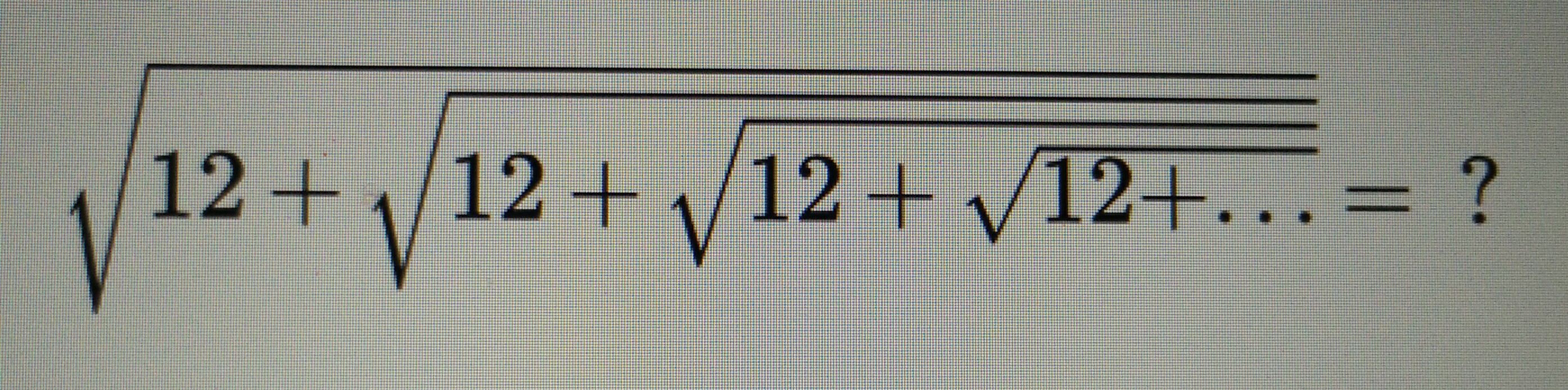
Puzzle #126 Graphic
The figure states it all…Happy rooting!
Here is another nice puzzle I saw on brilliant.org
Puzzle #126 Graphic
The figure states it all…Happy rooting!
Lot of correct answers to the puzzle – the ones who sent the correct answer include Siddharth Mulherkar (good to see you on the blog!), Sandeep Singhal, Ritesh Banglani, Aditya, Pratik Poddar, Suman Saraf, Karan Sharma (my nephew who gave me the puzzle), Prakhar Prakash, Amit Mittal and Shruti Mittal. Well done all!
I am taking the liberty of reproducing the answer directly from Ritesh Banglani. The answer is 6666600.
If you fix a number for one decimal position, the other numbers can be arranged in 4! ways.
The sum of all those numbers is 4! * (1+3+5+7+9)
If we do this for every decimal place, we have to add (10^4+10^3+10^2+10^1+10^0)
So the total sum is 4! * (1+3+5+7+9) * (10^4+10^3+10^2+10^1+10^0) = 6666600
Hope you all enjoyed the puzzle!
Here is a wonderful small teaser I got from the site brilliant.org. I have seen at least two solutions to this puzzle, so try your creativity, there might be more.
Look at the equation
Add any mathematical operators in the above equation to balance the two sides, with the following exceptions:
As always, please send your answers as comments within the blog (preferred), or send an e-mail to alokgoyal_2001@yahoo.com. Please do share the puzzle with others if you like, and please also send puzzles that you have come across that you think I can share in this blog.
Happy New Year!
Apologies for not being able to send the answer last weekend.
I got many correct answers for this one, and people sent different correct answers. Ones who sent correct answers include Pratik Poddar, Akash Tayal, Sandeep Singhal, Parag Dhanuka, Prakhar Prakash, Atul Tewari, Divya Mittal, Suman Saraf and Rahul Rane.
I am reproducing the answer from Sandeep, which I thought was the simplest (also sent by many others):
Weigh 50 coins against 50
If equal left out coin is odd and can be weighed against any coin.
If unequal, take any heap and 25 against 25.
If equal the other heap has the odd coin and if the other heap was heavier in the fist weighing, odd one is heavier and vice versa.
If unequal, odd one is in this heap and the odd one is heavier if this heap was heavier on the first weighing and vice versa…
Many people sent variations of this method, e.g. here is the answer from Pratik Poddar:
Divide the set of 101 coins in 3 sets:
Set A of 33 coins, Set B of 33 coins and Set C of the remaining 35 coins
Weight Set A and Set B. Without loss of generality, two cases are possible:
a) Set A == Set B
b) Set A > Set B
In the first case, we know that the counterfeit coin is in Set C, and Set A and B are all genuine coins. Using the coins of A and B, we create a 35 coin set which we know is genuine. Just weighing this against C tells us whether the counterfeit coin is heavier or lighter.
In the second case, we know that Set C is all genuine coins. Remove 2 coins from Set C. And weigh Set C against Set A, if Set A == Set C, Set B has counterfeit coin and its lighter. If Set A > Set C, Set A has counterfeit coin and is heavier.
In general, as long as you weight 26 or more coins on one side in the first weighing or (ceiling of x/2 for x coins), one can get to the answer.
Hope you enjoyed the puzzle!
This is a gem of a puzzle that my nephew, Karan, gave to me yesterday. He and I came up with different ways to come to the answers, and there are probably many more ways.
For all the possible 5 digit numbers with the digits 1, 3, 5, 7 and 9. Each of the digits can appear only once in a number and all of them need to appear in every number (therefore 11379 is not a valid numbers). What is the addition of all these numbers?
As always, please send your answers as comments within the blog (preferred), or send an e-mail to alokgoyal_2001@yahoo.com. Please do share the puzzle with others if you like, and please also send puzzles that you have come across that you think I can share in this blog.
Happy counting!
Wonderful puzzle and I got many correct answers. Ones to send the answers were Pratik Poddar, Prakhar Prakash, Suman Saraf, Karan Sharma and Girish Tutakne.
The answer is that it can’t be done for 6 but can be done for 7 trees. Generally, can’t be done for even number of trees but can be done for odd number of trees. I am copying Girish’s answer verbatim (thanks Girish).
Explanation: Number trees 1 to 6 (or 7 or n). Each sparrow takes the tree number of the tree it is on. At the start, the total number achieved by adding the “sparrow-numbers” is 21 (or 28 or n.(n+1)/2).
With every move, the total sparrow number stays the same because for every sparrow increasing its sparrow number by +1 by moving to the right, a sparrow reduces it’s sparrow number by -1 by moving to the left.
If all sparrows need to be on the same tree, they need to be on the tree with number equal to the average of the 6 (or 7 or n) sparrows. This is only possible for n being odd because the average will be (n+1)/2, which is a natural number only for n being odd. And as it the central tree for all odd n, every odd n has a solution.
Hope you all enjoyed the puzzle!
Found this intriguing question in the book Mathematical Circles (Russian Experience) by Dmitri Fomin, Sergey Genkin and Ilia Itenberg. I have not done this before, and do not know, therefore, how easy or difficult this is.
There are 101 coins, and only one of them differs from the other (genuine) ones by weight. We have to determine whether this counterfeit coin is heavier or lighter than a genuine coin. How can we do this using two weighings?
As always, please send your answers as comments within the blog (preferred), or send an e-mail to alokgoyal_2001@yahoo.com. Please do share the puzzle with others if you like, and please also send puzzles that you have come across that you think I can share in this blog.
Happy weighing!
This puzzle turned out to be more difficult than what I thought it was. There was only one correct answer – from Suman Saraf – very well done!
The answer is 40 feet. There were a couple of people who sent 42 as the answer.
The trick is to flatten it out and take the path as shown in the figure, and from the sides of the right angled triangle, you can figure out the distance of the hypotenuse which is the path that the spider takes.

Puzzle 121 Answer
Hope you all enjoyed the puzzle!
This is a very cute puzzle borrowed from the book Mathematical Circles (Russian Experience) by Dmitri Fomin, Sergey Genkin and Ilia Itenberg. It is a wonderful book for middle graders.
There are six sparrows sitting on six trees, one sparrow on each tree. The tress stand in a row, with 10 meters between any two neighbouring trees.If a sparrow flies from one tree to another, then at the same time some other sparrow flies from some other tree to another the same distance away, but in the opposite direction. Is it possible for all the sparrows to gather on one tree? What if there are seven tree and seven sparrows?
As always, please send your answers as comments within the blog (preferred), or send an e-mail to alokgoyal_2001@yahoo.com. Please do share the puzzle with others if you like, and please also send puzzles that you have come across that you think I can share in this blog.
Happy flying on the trees!
Apologies for a long absence, was traveling abroad on the last two weekends and hence could not post.
This was a difficult puzzle, and I received answers from only 3 people – Pratik Poddar, Rahul Rane and Suman Saraf. Well done all!
I am replicating the original solution in Martin Gardner’s book. The answer is two trips, i.e. the electrician will need to go down once and the come back up, and with these trips he can figure out all the wires. Let’s see how!
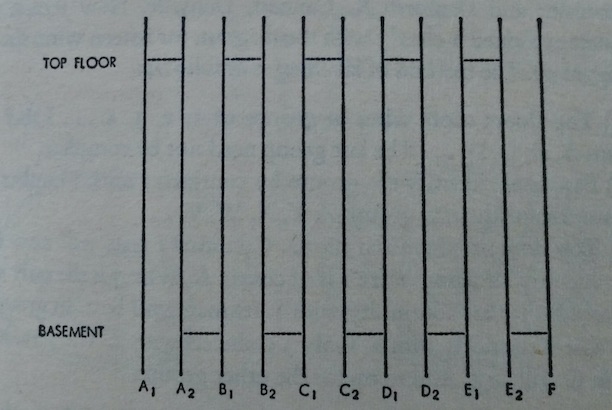
Puzzle 120 answer graphic
On the top floor, the electrician shorted 5 pairs of wires (as shown in the figure above), leaving one free wire. Then he walked to the basement and identified the lower ends of the shorted pairs by means of his “continuity tester”. He labeled the ends as shown in the figure above, then shorted them in the manner indicated.
Back on the top floor, he removed all the shorts but left the wires twisted at insulated portions so that the pairs were still identifiable. He then checked for continuity between the free wire (F) and some other wire. When he found the other wire, he was able to label it as E2 and identify its original pair as E1. He then used the continuity tester between E1 and another wire, which can then be marked as D2 and also mark D1. Continuing in this fashion all ends can be identified.
As one will notice, this procedure will work for only odd number of wires. There are other more generic solutions, also captured within Martin Garder’s book and also contributed by Pratik Poddar. Interested reader may read on this link http://www.cseblog.com/2009/10/this-puzzle-was-asked-to-me-last-year.html
Hope you all enjoyed the puzzle.
 | Senthil Kumar VS on Solution to Puzzle #200: Achie… |
 | Alok Goyal on Puzzle #200: Achieve your… |
 | Vishal Poddar on Puzzle #200: Achieve your… |
| Alok Goyal on Puzzle #200: Achieve your… |
 | Abdul on Puzzle #200: Achieve your… |
 Alok Goyal's Puzzles Page