Solution to Puzzle #90: The Three Gamblers

Fabulous response for the puzzle…one of the best weeks since I started the puzzle blog two years back…thanks and keep puzzling.

I got three correct answers (of course other than Vaibhav Kalia who had contributed the puzzle). The answer is “I am Martin”. The best way to explain the answer came from Anubhav Garg, which I am reproducing here:

Working:

Walter Martin Steve
Final x x x
Final-1 3x/2 x x/2
Final-2 3x/2 x/2 x
Initial 3x/4 5x/4 x

Note that x is the same as 4x/4, which means that the three people Walter, Martin and Steve should have initial amounts in the ratio of 3:5:4…which will mean that if I have 50 cents, I must be Martin.

Some people misunderstood the variation – what I had meant was that all three come back to the position they started from. You can figure out the answer with a little bit of trial and error that the three will have starting coins in the ratio of 1:2:2, and that the cycle can continue endlessly. Since Steve and Martin have coins that are a multiple of 2, in this case I must be Walter!

Hope you enjoyed the puzzle.

Posted in Solution | Tagged , , | Leave a comment

Puzzle #90: The Three Gamblers

Got this very nice puzzle from Vaibhav Kalia a while back, posting it on his behalf here.

The three of us made some bets. First, Walter won from Martin as much as Walter had originally. Next, Martin won from Steve as much as Martin then had left. Finally, Steve won from Walter as much as Steve then had left. We ended up having equal amounts of money. I started with 50 cents.

Who am I?

As a variation of the puzzle, also try the situation where after the three exchanges, you are back to where you started from – in that situation if I have 45 cents – who am I?

As always, please send your answers directly to me at alokgoyal_2001@yahoo.com. If you like the puzzle, please share it with others. If you have interesting puzzles to share, please send them to me at my e-mail given above.


Happy gambling!

Posted in Puzzles | Tagged , | Leave a comment

Solution to Puzzle #89: Chameleons on an Island

Thanks for trying this puzzle. I only got one correct answer  – from Gyora, and an “almost correct” and therefore a special mention, from Nandini, a 10 year old from Gurgaon. Well done Gyora and Nandini.

I am taking the liberty to reproduce one of the answers posted on Gurmeet’s site itself, which is how I had solved it too.

Any meeting of chameleons (of different colour) leads to a change in their numbers like this: -1/-1/+2. Thus, during any such meeting, the difference in numbers of any two species changes by three, or not at all. Now, imagine the penultimate step, just before all chameleons turn into the same colour: there must be two species with one specimen each. Therefore, we have to get to a point where the difference in population between two of the three species is zero. But this cannot be, as we start out with differences of two and four, and we can only change them in steps of three.

Hope you enjoyed the puzzle.


Posted in Solution | Tagged , | Leave a comment

Puzzle #89: Chameleons on an Island

This is a very sweet puzzle I picked up from Gurmeet’s puzzles at http://gurmeet.net/puzzles/ (Thank you Gurmeet for such a wonderful collection of puzzles!). I tried this on a train ride with my two daughters, and my younger one (now 8 years) gave me the hint to solve the puzzle – so hope that will encourage all the younger lot to try the puzzle as well.

On an island live 13 purple, 15 yellow and 17 maroon chameleons. When two chameleons of different colors meet, they both change into the third color. Is there a sequence of pairwise meetings after which all chameleons have the same color?

As always, please send your answers directly to me at alokgoyal_2001@yahoo.com. If you like the puzzle, please share it with others. If you have interesting puzzles to share, please send them to me at my e-mail given above.


Happy changing colors and a very Happy Republic Day to all of you!


Posted in Puzzles | Tagged , | Leave a comment

Answer to Puzzle #88: Ken Ken Puzzles

I got only a few answers to this puzzle, and all of them correct. In my opinion, the difficult one was pretty difficult – thanks to those who attempted it, and more so to those who sent a correct answer. Abhinav Jain and Deepak Mittal sent the correct answers – congratulations to both!

Attaching the correct answers here:

Answer to Puzzle#88

Answer to Puzzle#88

Hope you all enjoyed the puzzle!

Posted in Solution | Tagged , | Leave a comment

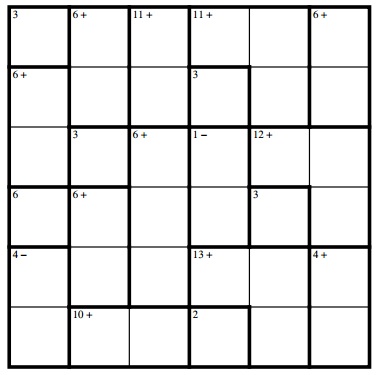
Puzzle #88: Ken Ken Puzzles

Thanks to Alok Mittal for introducing me to Ken Ken puzzles through his Mathematical Circle classes – I spent a good chunk of my last week trying to solve the Ken Ken puzzles. Liked them so much, that I thought it would be worth sharing them.

Ken Ken puzzles are like a Sudoku, in the sense that you have to fill out unique number without repetition in every row and column, and also satisfy the specific condition in each of the bolded areas (condition specified in top left). Detailed instructions on this link:

http://www.kenkenpuzzle.com/howto/solve

Here is an example:

Puzzle 88 - Example

Puzzle 88 – Example

Answer: 3214, 1423, 4132, 2341

Here are two puzzles – first one is easy and the second one is difficult.

Puzzle 88 - Easy

Puzzle 88 – Easy

and the difficult one…

Puzzle 88 - Difficult

Puzzle 88 – Difficult

As always, please send your answers directly to me at alokgoyal_2001@yahoo.com. If you like the puzzle, please share it with others. If you have interesting puzzles to share, please send them to me at my e-mail given above.

Happy Ken Ken’ing!

Posted in Puzzles | Tagged , | Leave a comment

Solution to Puzzle #87: The Magic Triangle (Challenge Puzzle!)

A very happy new year to all readers and thank you for a wonderful response to the blog overall and this puzzle in specific. Last year people from exactly 100 different countries accessed these puzzles – thank you all!

This was a challenge puzzle, and instead of one, I decided to give away a gift to two people (please bear with me, that is coming separately in an e-mail!) – R. Ganesh (Tokyo) and Ashish Tutakne (Bangalore) in the new generation. I received very many correct solutions though that included Smiti Mittal, Muskaan Mittal, Aman Singla, Vinay Pahlajani, Suman Saraf, Gyora and Alok Kuchlous – thanks and well done!

The answer is that it can be done. Here are the complete set of answers (thanks to Alok Kuchlous for writing a program to do this!) – please read them for the triangle from top to bottom and left to right:

[0, 5, 9, 6, 3, 2, 1, 7, 4, 8] Sum: 14
[0, 9, 5, 2, 3, 6, 8, 4, 7, 1] Sum: 14
[1, 5, 7, 2, 6, 0, 8, 3, 4, 9] Sum: 13
[1, 6, 7, 5, 3, 4, 0, 9, 2, 8] Sum: 14
[1, 7, 5, 0, 6, 2, 9, 4, 3, 8] Sum: 13
[1, 7, 6, 4, 3, 5, 8, 2, 9, 0] Sum: 14
[8, 2, 3, 5, 6, 4, 1, 7, 0, 9] Sum: 13
[8, 2, 4, 9, 3, 7, 0, 5, 6, 1] Sum: 14
[8, 3, 2, 4, 6, 5, 9, 0, 7, 1] Sum: 13
[8, 4, 2, 7, 3, 9, 1, 6, 5, 0] Sum: 14
[9, 0, 4, 7, 6, 3, 1, 5, 2, 8] Sum: 13
[9, 4, 0, 3, 6, 7, 8, 2, 5, 1] Sum: 13

For a complete solution for children on how to arrive at the answer, please go to the following video:

Hope you all enjoyed the puzzle!

Posted in Solution | Tagged , | Leave a comment

Puzzle #87: The Magic Triangle (Challenge Puzzle!)

Hope you all had a great year and may 2015 be a less puzzling year than 2014!

Ending the year with a difficult puzzle, to which I do not know the solution. This is a challenge puzzle, i.e., the first person to send me the correct answer gets a prize, which will be an online coupon (though just a token!). So please get your competitive juices flowing and send me the correct answer directly at alokgoyal_2001@yahoo.com. I will post the correct answer on the weekend of 10th January.

Puzzle #87

Puzzle #87

Please look at the figure above.

Is it possible to place the numbers 0 through 9 in the circles in the above figure without repetitions so that all the sums of the numbers in the vertices of the shaded triangles are equal?

Happy new year!

Posted in Puzzles | Tagged , | Leave a comment

Solution to Puzzle #86: Add The Digits and Count

This was a difficult puzzle, and I got only one response and a correct one from Ganesh Ramani, my friend from IITD Comp Science and now in Tokyo – well done!

To arrive at the solution, lets begin with Variation 1:

An easy way to think about the solution for this is to assume that you have 9 (sum) + 3 (number of digits) = 12 balls that you have to divide into 3 non-zero partitions, which if you try to calculate will be  (12-1) C (3-1) = 11 C 2 = 55. From each of these partitions, subtract 1 to arrive at the number. For example, one way to divide 12 into 3 partitions is 10, 1, 1 ==> the number is 900. Another way would be 5,3,4 ==> the number will be 423. Each of these numbers will have digits that add up to 9. 11 C 2 = 55, which is the answer for this variation.

Lets use this principle to arrive at the answer for Variation 2:

We can use the above principle to arrive at all the possible ways of 3 digits totaling up to 18 by doing (18+3-1) C (3-1) = 20 C 2 = 190.

However, the problem is that some of the digits could be 10 or above as well, which is not valid. We, therefore, need to subtract from 190 all the numbers where any of the digits is turning out to be 10 or more. Let’s assume that the first digit is 10 or more, that will imply that the sum of the last two digits is 8 or less, which is the same as all three digits number with a total of 8, which is equal to (8+3-1) C (3-1) = 10 C 2 = 45. Since any of the three digits can be 10 or above, we need to multiply 45 by 3 to arrive at all the possibilities where one of the digits is more than 10, i.e. 3 x 45 = 135.

therefore the number of solutions where the digits add up to 18 = 190 – 135 = 55.

Notice that there is a trivial way to arrive at this answer by doing the following:

– There is only one number where the first digit is 0, and the remaining two add up to 18, which is 099

– There are two numbers where the first digit is 1, and the remaining add up to 17, which are 189 and 198

– Similarly if the first digit is 2, then there are 3 possibilities…all the way up to the first digit being 9, when there are 10 solutions.

therefore the total is 1+2+3+….+10 = 55

This method, however, is brute force and does not scale when the numbers get larger.

Original version can be figured out in the same way as Variation 2:

Since there are 6 digits here, the answer will be 23 C 5 – (6 x (13 C 5)) = 33649 – 6*1287 = 25927


Hope you enjoyed the puzzle!

Posted in Solution | Tagged , , , | 1 Comment

Puzzle #86: Add The Digits And Count

I found this beautiful puzzle on Brilliant.org very recently. A very different kind of puzzle, requires basic knowledge of combinatorics. I have also created a couple of simpler versions so that children can also attempt it.

Original Problem: How many integers between 1 and 1,000,000 have the sum of their digits equal to 18?

Variation 1: How many integers between 1 and 1,000 have the sum of their digits equal to 9?

Variation 2: How many integers between 1 and 1,000 have the sum of their digits equal to 18?

As always, please send your answers directly to me at alokgoyal_2001@yahoo.com. If you like the puzzle, please share it with others. If you have interesting puzzles to share, please send them to me at my e-mail given above.

Happy counting!

Posted in Puzzles | Tagged , , | Leave a comment