Solution to Puzzle #50: Cat and Mouse Tale

One of the best responses to any puzzle since I started last year – thanks a ton!

Radhika Goyal was the first one to send an answer for this puzzle – well done! In addition to her, I got correct answers on the first day itself from Muskaan Mittal, Anirudh Baddepudi and Anand Krishnan. Thanks all!

This was a relatively simple puzzle. Here is a link to the solution video:

Hope you all enjoyed the puzzle!

Posted in Solution | Tagged , | Leave a comment

Puzzle #50: Cat and Mouse Tale

This is a nice puzzle for children that I picked from the book “Moscow Puzzles” (Puzzle #88).

See the figure below: Cat has decided to take a nap. He dreams he is encircled by 13 mice: 12 gray and 1 white. The cat hears his owner saying “Cat, you are to eat each 13th mouse, keeping the same direction. The last mouse you eat must be a white one.” which mouse should the cat start from?

Puzzle 50: Cat and Mice

Puzzle 50: Cat and Mice

As always, please send your answers directly to me at alokgoyal_2001@yahoo.com. If you like the puzzle, please share it with others. If you have interesting puzzles to share, please send them to me at my e-mail given above.

Happy mice eating!

Posted in Puzzles | Tagged , | 1 Comment

Solution to Puzzle #49: The Absent Minded Bank Clerk

I surprisingly got much fewer responses than I expected, and in hindsight, the “two minute” qualifier probably scared people! Congratulations to Muskaan Mittal, a brilliant 9 year old, in being the first one to send the answer. Girish Tutakne and Ashish Gupta were the other ones.

The source (Martin Gardner) uses algebra to solve the puzzle. Clearly one can do that. Solution that I am presenting here does not use algebra, but requires a bit of trial and error along with some logic. Here is how it goes:

– Assume that the number is D.C (Dollar and Cents)

– Bank Clerk gave him C.D

– After the newspaper, he has C.D-5 (assuming there is no carryover)

On the way to the solution, following conclusions can be drawn:

#1: D is an odd number (after you subtract 5, it needs to be even as the number left is twice of the original check amount)

#2: C >=50 and D >= 25 (if this is not the case, then C needs to be exactly twice of D and D needs to be almost twice of C, actually a little more i.e. by 5 additional cents, both of which are not possible)

#3: D < 50 otherwise C will need to be more than 100, which is not possible since cents in a check need to be max 99

#4: Therefore, when one doubles D.C, there will be a carry over, and that means that C is also an odd number because of the carry over.

#5: The number, therefore, needs to be of the form D.2D+1

Beyond this, a little bit of trial and error leads to $31 and 63 cents which is the only answer.

Hope you enjoyed the puzzle!


Posted in Solution | Tagged , | Leave a comment

Puzzle #49: Two Minute Test – The Absent Minded Bank Clerk

This is a simple gem I found again in a Martin Gardner book – More Mathematical Puzzles and Diversions, Chapter 14, Puzzle #8. I urge all the adults who try this puzzle to put this as a 2-minute challenge for themselves, children might take more. No algebra please!

An absent minded bank clerk switched the dollars and cents when he cashed a cheque for Mr Brown, giving him dollars instead of cents and cents instead of dollars. After buying a five-cent newspaper, Brown discovered that he had left exactly twice as much as his original cheque. What was the amount of the cheque?

As always, please send your answers directly to me at alokgoyal_2001@yahoo.com. If you like the puzzle, please share it with others. If you have interesting puzzles to share, please send them to me at my e-mail given above.

Happy solving!

Posted in Puzzles | Tagged , | Leave a comment

Solution to Puzzle #48: The Twelve Matches

Once again, thank you for the overwhelming response, and I was very happy to see that the two correct answers came from two children – from Muskaan Mittal and Ashish Tutakne – well done! A very creative answer from Pankaj Kakkar as well!

There are many answers to this puzzle, the one I liked the most, I converted to a video, please see attached link:

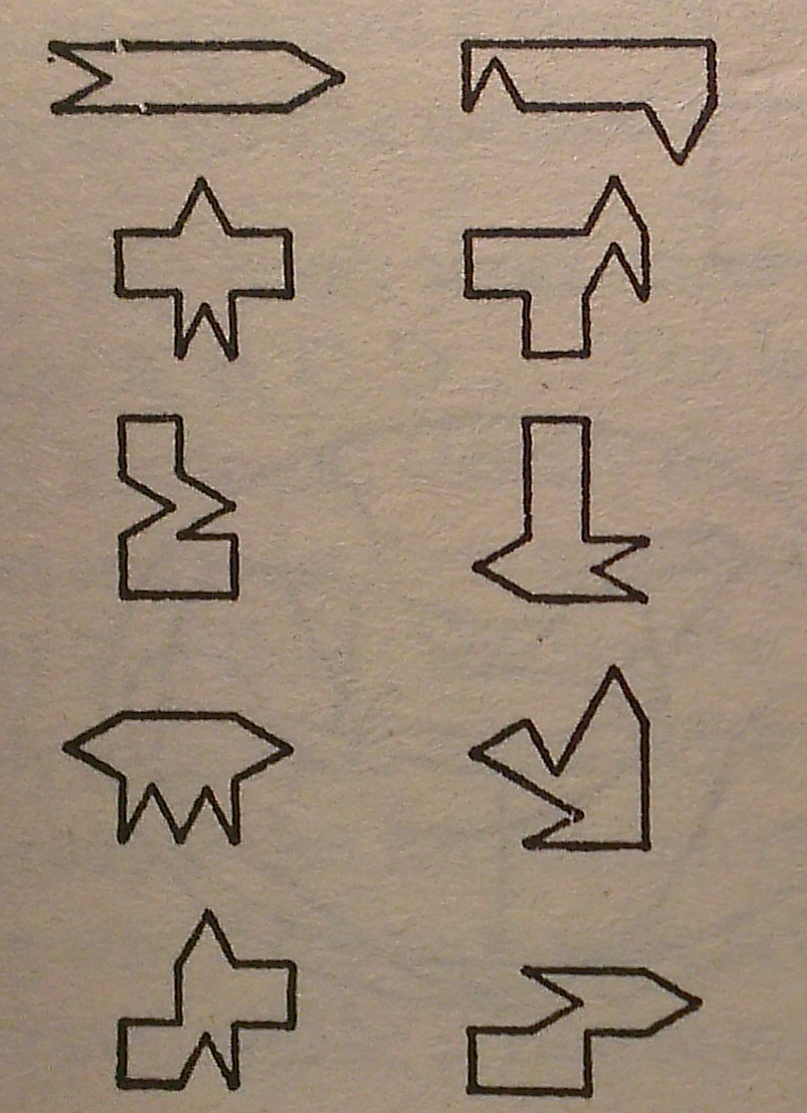
There are a large number of solutions that utilize the property that you can make triangular shapes with 4 matches (or even more) and make the area to be 4. Ashish Tutakne made one such, which I am including, as are many other variations of that principle.

Ashish Tutakne's answer

Ashish Tutakne’s answer

Answers to Puzzle #48

Answers to Puzzle #48

Pankaj Kakkar from Seattle, US, tried an interesting variation, and while I did not initially understand the answer, I think it is a very creative one and can help create area of all sizes from 0 to 9. I am reproducing the text of his answer directly:

Start with the 3×3 square. Imagine all the sides are rigid lengthwise (I.e., the 3 matches strung together on each side won’t get deformed or bent in any way). Look at the two vertical sides. Keeping one of them fixed in place, slide the other vertical side downward. The two other sides that were horizontal will now slant, and since they are rigid and fixed in length, the vertical sides will come closer. As you continue this process, the shape remains a 4 sided polygon, but the area decreases continuously, starting from 9 and going all the way down to zero, when the two vertical sides will align lengthwise and the slanting sides will also be vertical. Since the change in area is continuous, at some point it will be 4. The calculation of the other properties of the polygon at that point (basically just the slant angle) is left as an exercise for the puzzle master :).

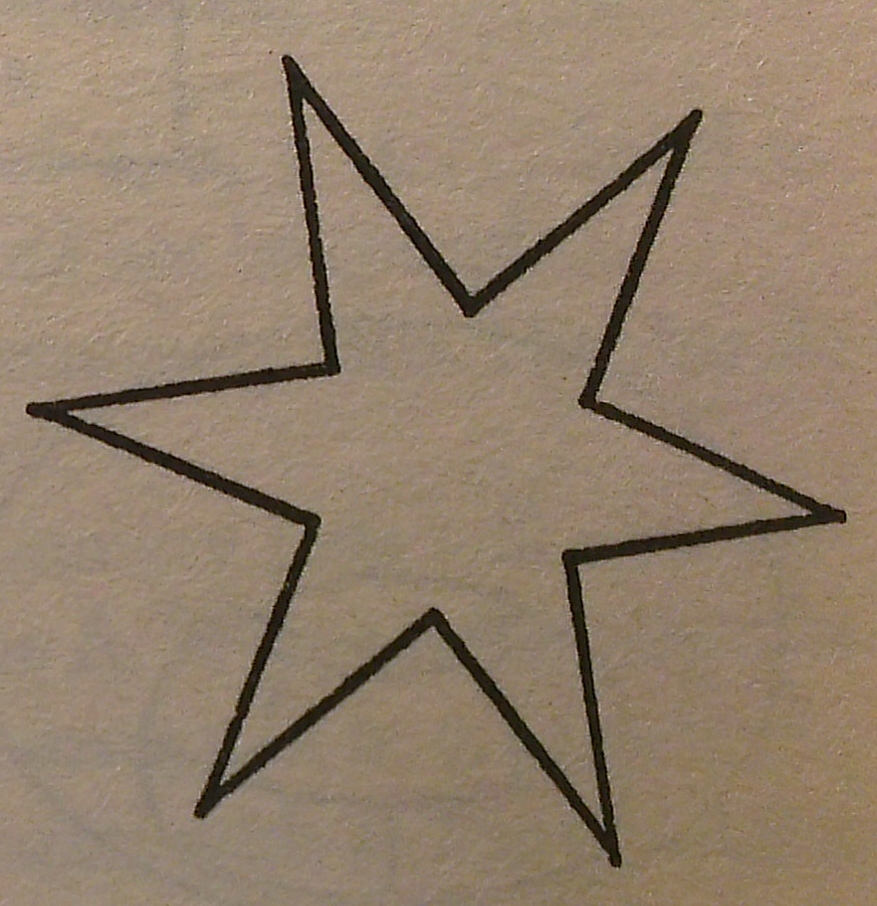
Finally, the most generic answer is to create a star using the twelve matches and adjust the width of the points of the star to get any area between 0 and 11.196, which is the largest area you can get using 12 sticks. Here is the answer:

Star Solution to Puzzle #48

Star Solution to Puzzle #48

Hope you all enjoyed the puzzle!

Posted in Solution | Tagged , | 1 Comment

Puzzle #48: The Twelve Matches

Martin Garder books have an unending supply of great puzzles, and here is another one from Mathematical Puzzles and Diversions, Chapter 12, puzzle #6.

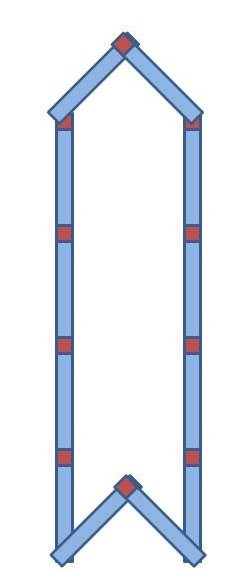
Given that a match is one unit long, it is possible to arrange 12 matches on a table in various ways to form polygons with areas that are exactly whole numbers. Two such examples are shown below, a square with an area of 9 square units and a cross with an area of 5 square units. The problem is to use all 12 matches to form the perimeter of a polygon with an area of exactly 4 square units.

Example of Polygons with 12 Matches

Example of Polygons with 12 Matches

Please note that there are multiple answers.

As always, please send your answers directly to me at alokgoyal_2001@yahoo.com. If you like the puzzle, please share it with others. If you have interesting puzzles to share, please send them to me at my e-mail given above.

Happy matching!


Posted in Puzzles | Tagged , | Leave a comment

Solution to Puzzle #47: Each Digit Only Once

First of all, need to thank Ankita and Mohit again for the puzzle…wonderful one. Got lots and lots of answers, and as it turns out, there are quite a few answers. Proper treatment of the answer requires a video but unfortunately I do not have my iPad with me this weekend, and hence the answer is only in text.

Before we get to the answers, some special mentions:

– Alok Kuchlous for writing a program to provide me all the answers where 3 digits + 3 digits = 4 digits, and the requirements of the puzzle are met

– Anirudh Baddepudi for being the only one who gave an answer for 4 digits + 2 digits = 4 digits

– Anku Jain for being the first one to send an answer

– Mittal family (Alok, Parul, Smiti and Muskaan) for making this puzzle a family bonding event

– Sanjeev+Armaan Dugar, Ankita and Adhish are the other notable mentions with correct answers.

The question required a fair bit of trial and error, but still one could reason the following –  Either x and y both need to be 3 digits each and z being 4 digits, or x & y can be 4 and 2 digits each (with z again as 4 digits) in a special scenario [explained below in Anirudh’s answer].

4 digits + 2 digits = 4 digits (reproducing Anirudh’s answer):

1978+65=2043

I found this puzzle quite intriguing and very challenging. I first realised that there has to be one number which is in the thousands in this, and automatically assumed that the thousands digit will be 1. This gave the the following digits left:

0, 2, 3, 4, 5, 6, 7, 8, 9. Then, I tried to play around with having two 3 digit numbers adding up to the four digit number, but it was quite frustrating realising that this doesn’t work. Hence, I tried something simpler, with having a four digit number as ‘x’ and a two digit number as ‘y’ in the equation. Therefore, 9 must be in the hundreds place in ‘x.’

Then, I decided to try make the problem simpler, trying it with having a sum of 2 ‘two’ digit numbers, such that its sum when added to 1900 with give me three different digits. For this, the sum of these two ‘2’ digit numbers must be more than a hundred. So looking at various sums, and rules with which the ending digits will be different (and with intuition that the two numbers will be consecutive or have a relationship like that as these questions usually will have an answer of that kind), I came up with this:

78+65=143. Plugging this in to the original form, I got:

1978+65=2043.

3 digits + 3 digits = 4 digits (reproducing Alok Mittal’s answer)

Here is some logic:

– The digit in the thousands place in z needs to be “1” as addition of two 3 digit numbers will be less than 2000 and since z is a four digit number it has to be at least 1000

– if zero is in one of the numbers being added, it can’t be at unit position (else the other unit number will repeat) or at hundreds position (else even with a carry, the result will be same as other hundreds place number). So it has to be in tens position. In such a case clearly the units sum has to produce a carry. Quickly one can run through cases here and there doesn’t seem to be a solution of this nature

– Zero is in the result number. The corresponding position numbers being added then have to produce a carry, and then its a hit and trail on those

Here is a short program that Alok Kuchlous wrote (which I cannot understand), and also all the answers:

————————– puzzle.rb ————————————–

numbers = [0, 1, 2, 3, 4, 5, 6, 7, 8, 9]

numbers.permutation.each do |p|
x = p[0..2].join(”).to_i
y = p[3..5].join(”).to_i
z = p[6..9].join(”).to_i
puts “#{x.to_s} + #{y.to_s} = #{z.to_s}” if x < y && x + y == z
end
——————————————————————————–

> ruby puzzle.rb | grep 0

Solutions:
246 + 789 = 1035

249 + 786 = 1035
264 + 789 = 1053
269 + 784 = 1053
284 + 769 = 1053
286 + 749 = 1035
289 + 746 = 1035
289 + 764 = 1053
324 + 765 = 1089
325 + 764 = 1089
342 + 756 = 1098
346 + 752 = 1098
347 + 859 = 1206
349 + 857 = 1206
352 + 746 = 1098
356 + 742 = 1098
357 + 849 = 1206
359 + 847 = 1206
364 + 725 = 1089
365 + 724 = 1089
423 + 675 = 1098
425 + 673 = 1098
426 + 879 = 1305
429 + 876 = 1305
432 + 657 = 1089
437 + 589 = 1026
437 + 652 = 1089
439 + 587 = 1026
452 + 637 = 1089
457 + 632 = 1089
473 + 589 = 1062
473 + 625 = 1098
475 + 623 = 1098
476 + 829 = 1305
479 + 583 = 1062
479 + 826 = 1305
483 + 579 = 1062
487 + 539 = 1026
489 + 537 = 1026
489 + 573 = 1062
624 + 879 = 1503
629 + 874 = 1503
674 + 829 = 1503
679 + 824 = 1503
743 + 859 = 1602
749 + 853 = 1602
753 + 849 = 1602
759 + 843 = 1602

Hope you enjoyed the puzzle!

Posted in Solution | Tagged , | Leave a comment

Puzzle #47: Each Digit Only Once

Got this puzzle from my cousin sister (Ankita) and her husband (Mohit) who live in Seattle and are both very smart puzzlers. Found it to be very intriguing and in full transparency, have not solved it yet. So I will enjoy this one as much as everyone else!

Find three numbers, x, y and z, such that

x + y = z

and together, x, y, z have all the digits (0-9) and each digit appears in exactly one of the three numbers.

As always, please send your answers directly to me at alokgoyal_2001@yahoo.com. If you like the puzzle, please share it with others. If you have interesting puzzles to share, please send them to me at my e-mail given above.

Happy crunching!

Posted in Puzzles | Tagged , | Leave a comment

Solution to Puzzle #46: A Fork in the Road

Got a pretty enthusiastic response to this puzzle, and I am very happy to see that many people tried it with their children. First person to come back with a correct answer was Anirudh Baddepudi from Singapore. Well done Anirudh! Others to respond correctly were Arunabh Bahadur (great to hear from him…my school time bactmate!), Muskaan Mittal and Adhish+Ameya Kulkarni.

Here is a way to think about this question:

Let’s assume that the native can answer in only “yes” or “no” and lets call the two roads R1 and R2 of which R1 is the correct answer. If we were to ask a simple question – “Does R1 lead to the village?” We will get an answer “yes” from the TRUTH guy and “no” from the “LIE” guy. If we were to apply the principle that truth applied to truth is still truth and lie applied to a lie becomes a truth [effectively 1*1 = 1 and (-1)*(-1)=1], one can ask the following question:

If I were to ask you “does R1 lead to the village”, what would your answer be?….we will get the right and the same answer from both the people.

I am also reproducing the answer from Adhish+Ameya, as I found it to be the easiest to follow. They also did a good role play with their son to show how this works – very innovative!

We initially began by asking the simple question… Does road A lead to village?


Lets assume Road A does lead to village

(L)Liar would say = No it doesn’t

(TT)Truthteller would say = Yes it does

Result: we don’t know if its the right road… because we don’t know if the native is a TT or a L and the answer is different depending on their tribe.

Conclusion: Need to ask a question which gets the same answer from both a TT and an L (in other words, we don’t care if it is an L or a TT we are speaking to).


We then came up with new question variations (with no success):

a) Would a liar tell me to take Road A to reach village (TT = NO; L= YES)

b) If you were a truthteller, would you tell me to take Road A (TT=YES; L=NO)

c) Would it be a lie to say Road A leads to village (TT= NO; L=YES)


Finally, we reformulated the question to avoid labelling the native as an L or a TT:


Assume Road A leads to Village

Question: Would someone from the other tribe say that Road A leads to the Village?


TruthTeller answer : NO (because the other tribe being liars would have said NO the road does not lead to village even though it does, and the TT is just relaying the truth).

Liar answer: NO (because the other tribe being TTs would have said YES the road does lead to village… but being a Liar, the native would answer the opposite of YES, which is NO)


The final piece here is that based on our question construct, if we get a NO, that means it IS the CORRECT Road to the village and if we get a YES, then it is not.


Hope you all enjoyed the puzzle!


Posted in Solution | Tagged , | Leave a comment

Puzzle #46: A Classic…Fork in the Road

This is a classic puzzle, many of you have probably done it at some point in time. I was fortunate to have been introduced to this puzzle by none other than Prof. Edgar W. Dijkstra, who taught me a course on basic logic in University of Texas at Austin, and the question was given to me as my final exam in a 1:1 setting. Am so proud of that fact, that I am sharing a photograph from that day (at the end of the post), I am hoping that those of you who are from Computer Science background will appreciate why I feel so proud!

The question in its current form is taken from one of the Martin Gardner books, Mathematical Puzzles and Diversions, Chapter 3, puzzle #4.

A logician vacationing in the South Seas finds himself on an island inhabited by the two proverbial tribes of liars and truth-tellers. Members of one tribe always tell the truth; members of the other always lie.

He comes to a fork in a road and has to ask a native bystander which branch he should take to reach a village. He has no way of telling whether the native is a truth-teller or liar. The logician thinks a moment and then asks one question only. From the reply, he knows which road to take.

What question does he ask?

As always, please send your answers directly to me at alokgoyal_2001@yahoo.com. If you like the puzzle, please share it with others. If you have interesting puzzles to share, please send them to me at my e-mail given above.

Happy holidaying!

Photo with Dijkstra (10th Feb, 1994)

Photo with Dijkstra (10th Feb, 1994)

Posted in Puzzles | Tagged , | Leave a comment