Solution to Puzzle #45: Prime Numbers

Apologies for not posting the solution last week, was traveling out of town on vacation. Also need to thank everyone for a “bumper response” to the puzzle. I got more answers to this puzzle than any other puzzle in the recent past. What was heartening to see was that many children responded to the puzzle.

I got correct answers for the smaller version (i.e. until 17) from Muskaan Mittal and Anisha Goyal. For the longer version I got correct answers from Smiti Mittal, Andy De, Jeba, Anirudh Baddepudi and Radhika Goyal. Anirudh and Radhika were the only ones though he sent a generic solution, and one that is very easily doable. Congrats Anirudh and Radhika!

While there are many versions of the brute force method, the best way to think about the puzzle is the following:

– odd and even numbers have to alternate for obvious reasons

– 71 and 73 are both prime numbers

– Divide the numbers into two sequences… (2,4,6,…,70) and (71, 69, 67, ….,1)

Interleave the two in the following way:

71, 2, 69, 4, 67, 6, 65, 8, ……, 70, 1

You will notice that all additions of adjacent numbers in this sequence add up to 71 and 73. The method can be applied to any sequence ending in number “n” where “n” and “n+2” are primes. So we can do the same for sequence up to 29 fore example as well.

Hope you enjoyed the puzzle!


Posted in Solution | Tagged , , | Leave a comment

Puzzle #45: Prime Numbers

Beautiful puzzle I got today, attributed to my niece, Radhika. Got this puzzle from her Maths Olympiad book for Grade 7. Puzzle is solvable by all kids in grade 4 and above.

Here is the question – Arrange numbers 1 through 71 in a sequence, such that sum of any two consecutive digits in the sequence is a prime number.

Hint – For younger children, i.e. grade 4 and 5, try the same question for a sequence from 1 through 17.

As always, please send your answers directly to me at alokgoyal_2001@yahoo.com. If you like the puzzle, please share it with others. If you have interesting puzzles to share, please send them to me at my e-mail given above.

Happy sequencing!


Posted in Uncategorized | Leave a comment

Solution to Puzzle #44: Thinking Outside the Box

Response to this puzzle was the best we have had in the last 3 months – so thanks a ton…particularly want to thank all the friends from UK, Singapore and Greece who came in large numbers this time!

The first correct answer was from Akash Tayal, though he had an unfair advantage of being a Chemical Engineer, and thinks 3D by definition! Many others, including Jeba, Rohit, and then from Lalitha Bhaskara (an ex-colleague from SAP) also sent correct answers. Also got a creative answer from Rhea Mittal from Mumbai. I am taking the liberty of reproducing some of the answers I got.

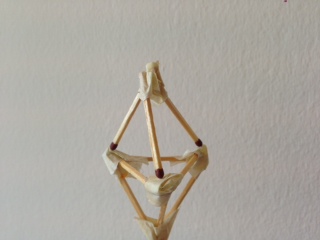
The trick is to think 3D, which is where “outside the box” comes in the title. Taking the existing triangle as the mid plane, with three matches more on each side you can create two pyramids that share the existing triangle as the base. Total of six external face triangles and one common base triangle.

Correct Answer (Figure by Lalitha)

Correct Answer (Figure by Lalitha)

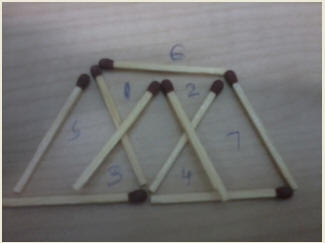
Also attaching the answer from Rhea. It is not 100% correct by the strict definition of the question, but a very creative answer – well done Rhea.

Creative answer from Rhea

Creative answer from Rhea

Hope you all enjoyed the puzzle!

Posted in Uncategorized | 1 Comment

Puzzle #44: Thinking Outside the Box

This is a nice cute puzzle with a “small” trick – I took this from the book “The Moscow Puzzles” by Boris A. Kordemsky (Puzzle #175).

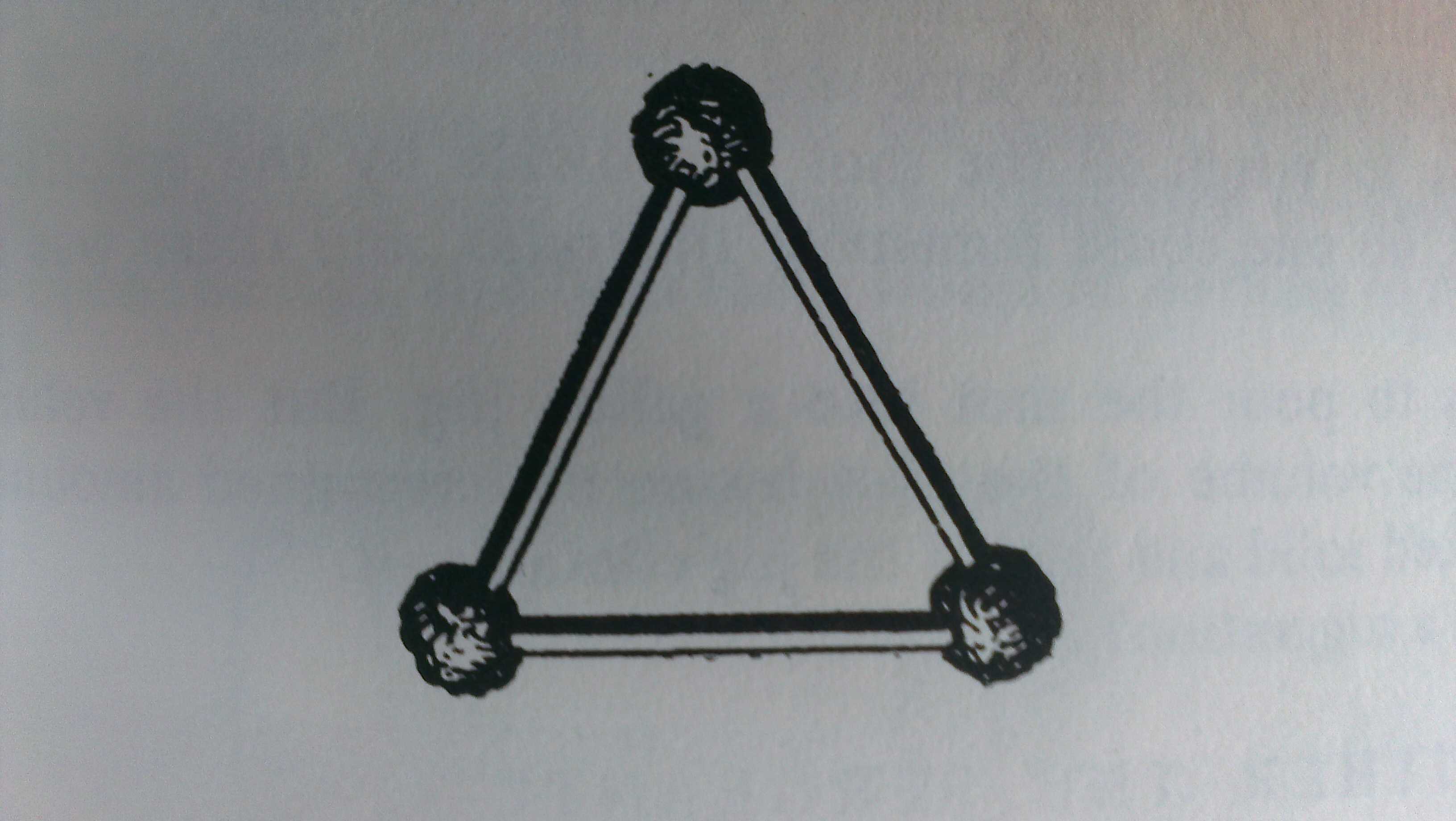
In the diagram, 3 matches are connected with balls of plastic to make an equilateral triangle. Can you form 7 such triangles with 9 matches?

Seven Triangles

Seven Triangles

As always, please send your answers directly to me at alokgoyal_2001@yahoo.com. If you like the puzzle, please share it with others. If you have interesting puzzles to share, please send them to me at my e-mail given above.

Happy thinking!


Posted in Puzzles | Tagged , , | 1 Comment

Solution to Puzzle #43: The Triangular Duel

This is the best response to a puzzle in recent times – thanks everyone!

This was a slightly difficult question, the first correct answer for the first part came from Girish Tutakne again. Only one fully correct answer came from Anirudh Baddepudi, a 14 year old from Singapore. Well done Anirudh – truly brilliant!

I liked Anirudh’s answer and his articulation a lot and hence taking the liberty of reproducing his answer completely.

As the question said that each man is a logical thinker, I thought about what each man would do if it were his turn to shoot. As Brown and Smith each know that the other is their greatest threat, their motive will be to shoot each other if it is their turn, and if the other is still alive. As for Jones, he will not be targeted by Brown or Smith until one of them are dead, so if he has a shot and the other two are alive, he will shoot to the floor (not kill anyone). Therefore, as Jones will be at the playing field with 2 people left regardless, he has the best chance of survival. This is also proved in solving the second question:

I decided to systematically look at the chance of survival for all three people.

First, I looked at Brown:

In his duel with Smith, if he does not get the first shot he dies. So, he has a 1/2 chance of having the first shot. Then, he has a 4/5 chance of killing Smith, and if he does not, then he dies in Smith’s next shot. Thus, he has a (4/5 * 1/2) = 4/10 = 2/5 chance of surviving his duel with Smith. Then, if he kills Smith, Jones will have the next shot at him. However, this is where I got a little confused, as they can keep shooting each other infinitely with none of them dying. So, I looked at this as a never ending geometric series with terms (4/10, 4/100, 4/1000, 4/10000………..) I found these terms as I looked at each round of both of them shooting/missing as such:


1) 1/2 * 4/5 = 4/10

2) 1/2 * 1/5 * 1/2 * 4/5 = 4/100

3) 1/2 * 1/5 * 1/2 * 1/5 * 1/2 * 4/5 = 4/1000………


So then, the formula for the sum of an infinite geometric series is S= a/(1-r), with S being the sum, ‘a’ being the first term, and ‘r’ being the ratio between each of the terms. So if this formula is applied:


S=a/(1-r)

S= (4/10)/(1-(1/10))

S= (4/10) / (9/10)

S= 4/9

Therefore, Brown has a 4/9 chance of surviving his duel with Jones once Smith is dead. So, his overall probability of surviving is:


2/5 * 4/9 = 8/45


Next, I looked at Smith: 

He has a 1/2 chance of getting the first shot against Brown, and if he gets the first shot, he kills Brown. However, he also has a 1/2 chance of not getting the first shot. In this scenario, he must hope that Brown misses his first shot, so he can kill him. This probability of surviving is (1/2 * 1/5) = 1/10. Therefore, his chance of surviving against Brown is 1/2 + 1/10 = 3/5.

If he kills Brown, Jones will have the next shot. Then, for Smith to survive, Jones must miss this shot, so the overall probability of Smith surviving is:

3/5 * 1/2 = 3/10.

Now this makes the rest fairly simple. We know that the sum of the chance of survival for each man must be 1, so Jones’ chance of survival is naturally:

1 – (3/10+8/45)

= 1 – (215/450)

= 235/450

= 47/90 = Jones’ probability of surviving.

So, as stated earlier, Jones has the greatest chance of survival out of the three men, not what one would assume when they first read the problem!

Hope you all enjoyed the puzzle!


Posted in Solution | Tagged , | Leave a comment

Puzzle #43: The Triangle Duel

Yet another wonderful puzzle from the Martin Gardner collection. This one is from “More Mathematical Puzzles and Diversions”, Chapter 5, Puzzle #9. This one involves probability, and hence difficult for children who do not understand probability at all.

Three men, Smith, Brown, and Jones, agree to participate in a pistol “duel.” The three men decide who goes first by drawing straws and each man is to wait their turn before firing upon either of the other men. After the first round of shots fired, the men will proceed in the same order until there is one man standing. All three men know that Smith is 100% accurate, Brown is 80% accurate, and Jones is 50% accurate.

Assuming that all three men are intelligent, logical thinkers, who has the best chance of winning? What is each man’s probability of surviving?

Note: the second question is a bit more difficult, so not for children.

As always, please send your answers directly to me at alokgoyal_2001@yahoo.com. If you like the puzzle, please share it with others. If you have interesting puzzles to share, please send them to me at my e-mail given above.

Happy dueling!


Posted in Puzzles | Tagged , | Leave a comment

Solution to Puzzle #42: How Wide is the River

Great response to this puzzle – thank you so much! I was surprised to see the activity in countries like Germany and Singapore this time, in addition to the activity I see in India and US – appreciate all the readers very much.

First correct answer was from Girish Tutakne, and the only correct answer among the younger adults was from Shruti Mittal yet again. Well done both!

While it was easy to solve the puzzle using algebra, but the fun  of the puzzle was solving without it. Here is a link to the solution.

Hope you enjoyed the puzzle!


Posted in Solution | Tagged , | Leave a comment

Puzzle #42: How Wide is the River

Seems like the puzzle collections from the Martin Gardner books is unlimited, and also of outstanding quality. While flipping through one of the books (Mathematical Puzzles and Diversions), I found another gem in Chapter 12. Some people have told me that they get scared by the complexity of these puzzles, and hence an upfront clarification, that the puzzle below does not require any algebra, just simple (and yet tricky) logic. Please try it, and make your children try it.

Two ferryboats start at the same instant from opposite sides of the river travelling across the water en route at right angles to the shores.  Each travels at a constant speed but one is faster than the other.  They pass at a point 720 meters from the nearest shore.  Both boats remain at their slips for ten minutes before starting back.  On the return trip, they pass 400 meters from the other shore.  How wide is the river?

Al always, please send your answers directly to me at alokgoyal_2001@yahoo.com. If you like the puzzle, please share it with others. If you have interesting puzzles to share, please send them to me at my e-mail given above.

Happy ferrying!


Posted in Puzzles | Tagged , , | 1 Comment

Solution to puzzle #41: Yet Another Handshake Puzzle

I was surprised this time to see only one correct answer from Alok Kuchlous, one of the best puzzle solvers I have known since my IIT days. I also got a very good attempt from Shruti Mittal (from Mumbai), but was not a completely correct answer.

I liked the question as it can explain some very basic concepts about “odd” and “even” to children. Here is the solution:

If you add up the number of handshakes by each person, then the final number has to be even – this is because each handshake results in a count of 2. If the number of people with odd number of handshakes is odd, then the final number of handshakes will be:

odd * odd + even * whatever = an odd number + an even number = an odd number, which cannot be true.

Hope you enjoyed the puzzle!


Posted in Solution | Tagged , | Leave a comment

Puzzle #41: Yet Another Handshake Puzzle

This is yet another handshake puzzle, and again from one of the Martin Gardner collections. This one is from Second Book of Mathematical Diversions and Puzzles…Martin Garder, Page 55

Here is the puzzle:

Prove that a t a recent convention of biophysicists the number of scientists in attendance who shook hands an odd number of times is even. The same problem can be expressed graphically as follows. Put as many dots (biophysicists) as you wish on a sheet of paper. Draw as many lines (handshakes) as you wish from any dot to any other dot. A dot can “shake hands” as often as you please, or not at all. Prove that the number of dots with an odd number of lines joining them is even.

Note: A good way for children to try this puzzle will be to try out within your family, and let them figure out why this is happening.

As always, please send your answers directly to me at alokgoyal_2001@yahoo.com and if you like the puzzle, please share with others.

Happy handshaking!

Posted in Puzzles | Tagged , | Leave a comment