Puzzle #176: Outsmart Your Teacher

This is a relatively simple puzzle from fivethirtyeight.com, a site from which I have posted many puzzles in the past. Variations of such puzzles have been posted in the past. I would encourage parents to try this with their children.

Two intelligent, honest students are sitting together at lunch one day when their math teacher hands them each a card. “Your cards each have an integer on them,” the teacher tells them. “The product of the two numbers is either 12, 15 or 18. The first to correctly guess the number on the other’s card wins.”

The first student looks at her card and says, “I don’t know what your number is.”

The second student looks at her card and says, “I don’t know what your number is, either.”

The first student then says, “Now I know your number.”

What number is on the loser’s card?

As always, please send your answers as comments within the blog (preferred), or send an e-mail to alokgoyal_2001@yahoo.com. Please do share the puzzle with others if you like, and please also send puzzles that you have come across that you think I can share in this blog.

Happy guessing!
Posted in Puzzles | Tagged , | 3 Comments

Solution to Puzzle #174: Happy Birthday!

This puzzle was not an easy one, and one of the ways to make it easier was to solve it for a smaller number of candles and then try to solve for larger number of candles. There is a whole class of problems we can solve that way, and this method is called induction.

I received many correct answers and a few good attempts where the answers were not correct. Correct answers came from Abhinav Jain, Suman Saraf, Pratik Poddar and Praneeth. Very mentionable attempts  from Arushi & Ishir Gupta as well as Prakhar’s daughter. Well done all.

The answer is very close to 4! More precisely, it will take about 3.994987 blows. Why?

Let’s start with a smaller number of candles and work our way up. Suppose you have a cake with just a single candle. You’ll blow it out in one blow, for sure. Suppose there are two. Half the time you’ll blow them both out in one go, and half the time it’ll take two blows. Let’s make a list:

One candle: 1

Two candles: (1/2)⋅1+(1/2)⋅2=1.5
Three candles: (1/3)⋅1+(1/3)⋅(1+1.5)+(1/3)⋅(1+1)=1.83¯
Four candles: (1/4)⋅1+(1/4)⋅(1+1.83¯)+(1/4)⋅(1+1.5)+(1/4)⋅(1+1)=2.083¯

With each additional candle, you have an equal chance of blowing them out in one go and of only snuffing some specific number, leaving some to tackle on the next blow. Notice the pattern! For one candle, the average number of blows is one. For two, it’s 1+1/2. For three, it’s 1+1/2+1/3. For four, it’s 1+1/2+1/3+1/4. And so on. So to get the answer, we simply compute this harmonic sum:

∑  (1/i), i goes from 1 to 30 = ≈3.994987

Hope you all enjoyed the puzzle!

Posted in Solution | Tagged , , | Leave a comment

Solution to Puzzle #173: Dividing a Circle into 7 Parts

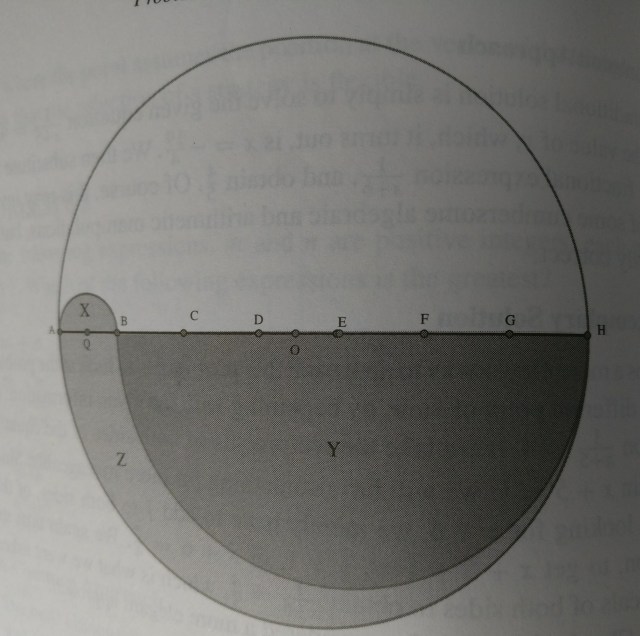
This was a beautiful puzzle and amongst my favourite geometry puzzles. Unfortunately I did not get a perfect answer from anyone, even though I did receive an answer from Abhinav Jain and Pratik Poddar. I am taking the liberty of reproducing the answer from the book “Problem Solving Strategies in Mathematics”, which is where this puzzle was taken from.

Please look at the figure below:

Solution to Puzzle #173

Solution to Puzzle #173

Typical solution to this puzzle is to draw concentric circles, but the exact radii of these circles is very hard to measure.

Instead we begin with our given circle and mark off a length along the diameter which is one-seventh of the distance from one endpoint as shown in the figure above. Please look at the area Z+X. Notice that the diameters of X, Y and the original semi-circle are in the ratio of 1:6:7, and therefore their areas are in the ratio of 1:36:49.

Please note that Z happens to be Area of the original semi-circle minus area of Y, and therefore ratio of Z to the original semicircle is (49-36):49 or 13:49, and therefore ratio of Z+X to the original circle is (13+1):49, which is 2:7, and if we therefore extrapolate, the ratio of (Z+X) to the original circle is 1:7, so we have been able to divide the original circle into a 1/7th part.

We can similarly draw semicircles with diameters AC, AD, AE, AF, AG and AH, which when taken together partition the circle into seven parts.

Hope you all enjoyed the puzzle.

Posted in Solution | Tagged , | 1 Comment

Puzzle #175: The Three Bag Puzzle

Apologies for a long break, I was in the middle of some hectic travel, both for personal and business reasons. But normal service resumes 🙂

Thanks to Suman Saraf yet again for recommending this puzzle. A variation of this puzzle was posted very early when I started 4 years back. Here it goes:

There are three children. These children need rewarding for good behaviour. I have six gifts.

  • I have three chocolate bars.

  • I have three giant lollypops.

Each child is going to receive two presents and, so they don’t know who is getting what, I put each pair of presents inside a brown paper bag and seal them. Only I know the distribution of the treats, but all the children know there are three of each treat and two treats in each bag.

The first child collects her bag and looks inside to see what presents she received. A curious neutral third party asks this first child a question to determine the breakdown of presents in her bag. The catch is that the child can only respond with the answers: “Yes”, “No” (or “I don’t know”). The child is a perfect logician, and always answers truthfully. What question can the outsider ask to determine the contents of the first gift bag?

What question can you ask the first child to determine the breakdown of presents in her bag?

For the purposes of this exercise, we can assume the chocolate bar and the lollypop have the same mass; This is meant to be a purely logic puzzle and does not rely on physical differences between the bags. There is no trick, gotcha, or tomfoolery in the answer.

Remember, the child can only answer your question with, “Yes”, “No”, or “I don’t know”.

As always, please send your answers as comments within the blog (preferred), or send an e-mail to alokgoyal_2001@yahoo.com. Please do share the puzzle with others if you like, and please also send puzzles that you have come across that you think I can share in this blog.

Happy gifting!
Posted in Puzzles | Tagged , | 2 Comments

Puzzle #174: Happy Birthday!

This is a very nice puzzle from fivethirtyeight.com (thanks to Suman Saraf for pointing this site to me).

It’s your 30th birthday, and your friends got you a cake with 30 lit candles. You try to blow them out, but each time you blow you successfully extinguish a random number of candles, between one and the number that remain lit. How many blows will it take, on average, to extinguish them all?

As always, please send your answers as comments within the blog (preferred), or send an e-mail to alokgoyal_2001@yahoo.com. Please do share the puzzle with others if you like, and please also send puzzles that you have come across that you think I can share in this blog.

Happy birthday!

Posted in Puzzles | Tagged , | 6 Comments

Solution to Puzzle #172: Divisibility by First 13 Numbers

This was perhaps too simple a problem, to the point that very few responded 😦 Thanks to Abhinav Jain and Pratik Poddar for sending in the correct answers.

The answer is 360,360.

We are already told that the answer for the first 9 numbers is 2520. We also know that:

  • 2520 should  be divisible by 10 (since it is divisible by 2 and 5)
  • 2520 should also be divisible by 12 (since it is divisible by 3 and 4)
  • It should not be divisible by 11 and 13, both of which are prime numbers

The answer, therefore, is 2520 x 11 x 13 = 360,360

Hope you all enjoyed the puzzle!


Posted in Solution | Tagged , | Leave a comment

Puzzle #173:Diving a Circle Into 7 parts

This is yet another wonderful puzzle sent by Suman Saraf. Thanks Suman!

Given a circle and it’s diameter, how can you partition it’s area into seven equal regions without using straight lines.

As always, please send your answers as comments within the blog (preferred), or send an e-mail to alokgoyal_2001@yahoo.com. Please do share the puzzle with others if you like, and please also send puzzles that you have come across that you think I can share in this blog.

Happy divisions!
Posted in Puzzles | Tagged , | 4 Comments

Solution to Puzzle #171: Buying Dimsums

Many puzzles sometimes give you a glimpse of some amazing brilliance that lies all around us – this was one such puzzle. While many of you gave the correct answer for the number (which is 11), and this included Abhinav Jain, Pratik Poddar, Anisha Goyal and I, no one could solve the generic version – except Arushi Gupta from California, a Grade XI student. Very well done Arushi!

As I dug more into it, there is a popular version of the puzzle known as the McDonald’s Chicken Nuggets puzzle, but I also found out that this is a well researched problems with some great mathematicians having lent their time to it. A largest number which cannot be expressed with the two relative primes is called a Frobenius number. For the interested reader, they should go to https://en.wikipedia.org/wiki/Coin_problem

Back in 1884, James Joseph Sylvester had figured out for any two relative primes a1 and a2, there are exactly (a1-1)*(a2-1)/2 number of integers that cannot be represented x*a1+y*a2.

Only in 1993, Zdzislaw Skupien´ (Krak´ow) gave a proper proof for the 2 integer problem, though it can be generalized to larger number of integers. Here is the proof, though I must confess that it is hard to follow (also apologize that instead of p and q, I have now used A1 and A2 which has made it easier to copy and paste).

The answer is a1*a2-a1-a2, or a different way to write it is (a1-1)*(a2-1)-1

Here is the proof:

Solution to Puzzle #171

Solution to Puzzle #171

Hope you all enjoyed the puzzle.


Posted in Solution | Tagged , | Leave a comment

Puzzle #172: Divisibility by first 13 numbers

I acquired a new book recently (thanks to Suman Saraf) – Problem Solving Strategies in Mathematics. Here is a problem from that book. It is a simple problem for adults, so will request people to show it to their children.

The smallest number that is divisible by the first none counting numbers (i.e. 1,2,3,…,9) is 2,520. What would be the smallest number divisible by the first 13 counting numbers?

As always, please send your answers as comments within the blog (preferred), or send an e-mail to alokgoyal_2001@yahoo.com. Please do share the puzzle with others if you like, and please also send puzzles that you have come across that you think I can share in this blog.

Happy counting!


Posted in Puzzles | Tagged , | 3 Comments

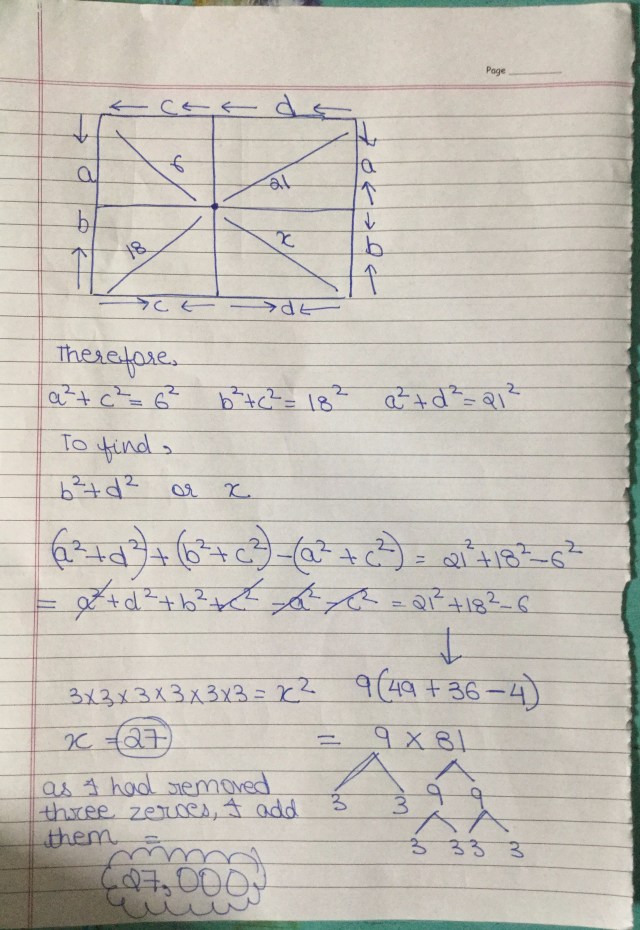
Solution to Puzzle #170: Rectangle and the Oil Well

I got many correct answers, thanks to all who responded. This was a “simple” application of pythogoras theorem. I got correct answers from Abhinav Jain, Pratik Poddar, Karan, Praneeth Ruthala, Suman Saraf and Mahi Saraf. While everyone sent me only the answer, I received a full solution from Mahi, which I am reproducing as it is – thanks Mahi!

The answer is 27,000. Please note that there is a very minor omission in Mahi’s answer at one place, where she meant to write 6^2 instead of 6.

Solution to Puzzle #170

Solution to Puzzle #170

Hope you all enjoyed the puzzle!


Posted in Solution | Tagged , | Leave a comment