Puzzle #151: Journey from 458 to 14

This is a beautiful teaser contributed by Pooja Singh, who tried this with her 9 year old. So will encourage everyone to try this, it could be a nice, 5-minute puzzle!

You begin with the number 458. You are only allowed two operations, each of which can be repeated any number of times:

– You can multiply the number by 2

– Remove the last digit, i.e. the one in the unit’s place (e.g. 8 in the number 458)

Your task is to get to the number 14, beginning with 458. Do this in the minimum number of steps.

As always, please send your answers as comments within the blog (preferred), or send an e-mail to alokgoyal_2001@yahoo.com. Please do share the puzzle with others if you like, and please also send puzzles that you have come across that you think I can share in this blog.

Happy number crunching!

Posted in Puzzles | Tagged , | 7 Comments

Solution to Puzzle #149: The Funny Plane Seating

Apologies for not posting the answer earlier – I was traveling last weekend.

This was a difficult problem on a relative scale, and I therefore received the correct from all the die hard puzzle solvers in addition to one my friend’s son – Danny, a 14 year old in Washington DC. Other people to send the right answers were Pratik Poddar, Abhinav Jain, Suman Saraf and Prakhar Prakash – well done all!

Those who have not tried it yet – I will highly encourage trying it before reading the answer – it is a beautiful puzzle!

The answer is 1/2. I am giving two explanations, one from Pratik (which I really liked) and the other from Suman (which is the way I did it as well):

From Pratik:

Only one of the two seats can be remaining when the last guy comes – either the seat allocated to the first person or the last person (anything else cannot be there can be easily proved by contradiction)

Now, since for all the people taking the seat after the first person and before the last person, there is no difference between the two seats.

So probability that the last person will get his correct seat is 0.5

From Suman:

At every turn, it is essentially a toss between the first seat and the last. If a person sits in the first seat, the last person gets his own seat. If the person sits in the last seat, the last person has to sit in the first seat. If he sits anywhere else we just defer the decision.

We could also represent this by a recurrence like:
P(n) = 1/n*1 + 1/n*0 + (n-2)/n*P(n-1)
Where P(n) is the probability that the last person sits on his own seat considering n people.
There is 1/n chance of sitting on the first seat (in which case the last guy definitely sits on his own seat)
There is 1/n chance of sitting on the last seat (in which case the last guy definitely doesn’t sit on his own seat)
There is n-2/n chance of sitting somewhere else, in which case the problem continues with a lesser person
P(1) = 1
It follows
P(2) = 1/2
P(3) = 1/2
and so on.
Hope you all enjoyed the puzzle!
Posted in Solution | Tagged , | Leave a comment

Puzzle #150: The Tutu Coin Puzzle :-(

This week marks a very sad week for me and for many of the regular readers of this blog. A very dear friend – Girish Tutakne (popularly known as Tutu at IIT Delhi)- passed away in a very unfortunate accident in Melbourne a few days back. Girish was one of the most regular contributors to this blog along with both his sons. Today’s edition is being dedicated to Tutu, and I am republishing a puzzle that was contributed by him a few months back. Even after I knew the solution, I continued to be baffled by the answer, and I know many others felt the same way. It is one of the best puzzles posted on this blog.

Suppose we have 2 coins, with radii 2 cm and 6 cm respectively. The coin with the 2 cm radius is rotated on the circumference of the bigger coin. How many times will it rotate before it comes back to it’s starting point?

As always, please send your answers as comments within the blog (preferred), or send an e-mail to alokgoyal_2001@yahoo.com. Please do share the puzzle with others if you like, and please also send puzzles that you have come across that you think I can share in this blog.

My heart goes out to the Tutu’s family – Devika, Ayush and Ashish. I do hope to see future participation from all of them.

Posted in Puzzles | Tagged , | 3 Comments

Solution to Puzzle #148: The First Black Ace

This was a bit of a  counterintuitive puzzle – four people sent the correct answers – Suman Saraf, Pratik Poddar, Abhinav Jain and Karan Sharma – well done!

The answer is the first card. It is a bit difficult to imagine intuitively that you should guess the first card in a pack of 52 cards as the one which has the highest probability of finding the first black ace. The challenge is that the probability is very low, but probability of it being in any other location is still smaller.

Here is how it works:

Probability that the first card is an ace is 2/52 (there are two possible black aces)

Probability that the second card is the first black ace is 50/52* 2/51 (please note that it is smaller than the first one by a very small factor – 50/51

…if we continue, the probability that the nth card is the first black ace is (copying the answer from Pratik):

50/52*49/51*48/50*47/49……(52-n)/(54-n) * 2/(53-n)

= 2*(52-n)/(51*52)

To max prob across n – minimise n
So I will bet on n=1

Hope you all enjoyed the puzzle!


Posted in Solution | Tagged , , | Leave a comment

Puzzle #149: The Funny Plane Seating

A very catchy puzzle contributed by my friend and entrepreneur, Pallav Pandey – thanks Pallav!

Imagine there are a 100 people in line to board a plane that seats 100. The first person in line realizes he lost his boarding pass so when he boards he decides to take a random seat instead. Every person that boards the plane after him will either take their “proper” seat, or if that seat is taken, a random seat instead.

Question: What is the probability that the last person that boards will end up in his/her proper seat?

As always, please send your answers as comments within the blog (preferred), or send an e-mail to alokgoyal_2001@yahoo.com. Please do share the puzzle with others if you like, and please also send puzzles that you have come across that you think I can share in this blog.

Happy seating!


Posted in Puzzles | Tagged , | 7 Comments

Solution to Puzzle #147: The “Aha” IBM Puzzle

This was a beautiful puzzle, but I did not receive as many answers as I would have liked. Correct answers came from Pratik Poddar and Suman Saraf. My younger daughter, Arushi (9), solved it with some help.

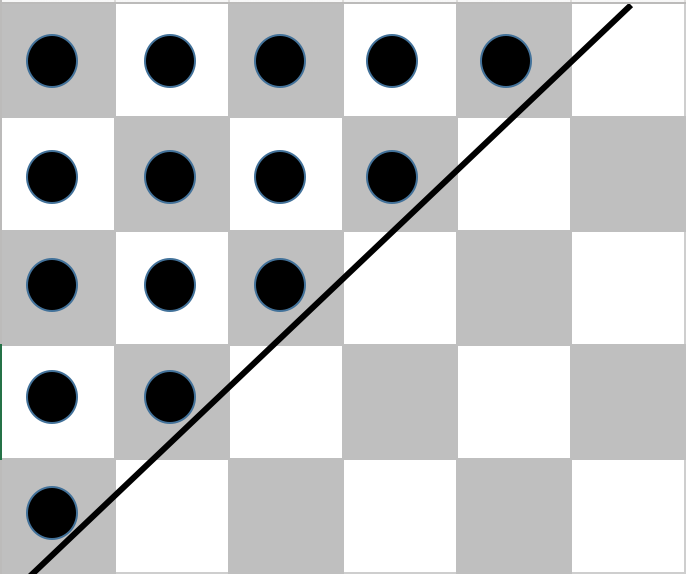
Answer to all the variations is “No”. Here is the explanation – look at the figure below:

Solution to Puzzle #147

Solution to Puzzle #147

I took the liberty of coloring the same grid in a chess like pattern. Notice that in any move, a penny on the black square can only move to another square with black color, and vice versa, one on white can only move to a white one. Also notice that even if a diagonal move was allowed, this principle remains true. Above the line, we have pennies on 9 black squares and 6 white squares. On the other side, there are 6 black and 9 white squares. Therefore 9 pennies from black squares above the line cannot find enough black squares below the line.

The above is true even if we remove one penny from a black square or even 2 pennies from a black square.

Hope you all enjoyed the puzzle!


Posted in Solution | Tagged , , | Leave a comment

Puzzle #148: The First Black Ace

Yet another wonderful puzzle from Martin Gardner’s book “The Colossal Book of Short Problems and Puzzles”. This one is a probability puzzle, and something you should try with your children.

A deck of 52 playing cards is shuffled and placed facedown on the table. Then, one at a time, the cards are dealt face up from the top. If you were asked to bet in advance on the distance from the top of the first black ace to be dealt, what position (first, second, third, …) would you pick so that if the game were repeated many times, you would maximize your chance in the long run of guessing correctly

As always, please send your answers as comments within the blog (preferred), or send an e-mail to alokgoyal_2001@yahoo.com. Please do share the puzzle with others if you like, and please also send puzzles that you have come across that you think I can share in this blog.

Happy gambling!

Posted in Puzzles | Tagged , | 5 Comments

Solution to Puzzle #146: The Proud Party Goers

Apologies for not being able to post last weekend, ended up in parenting duties more than I bargained for!

This was not a very difficult puzzle, but I did not get as many solutions. Congratulations to Suman Saraf, Gautam Kumar and Abhinav Jain for posting this puzzle.

The answer is is N-2/N, here is the explanation.

The largest share of “proud” people at the party — those who have more friends than their friends, on average — is (N-2)/N. To see why, let N>3 be the number of people at the party, and call two particular people in attendance X and Y. Suppose everyone is friends with everyone else, except that X and Y are not friends with each other. (In math terms, you have a complete graph with one edge removed.) In this case, it’s easy to see that everyone is proud except X and Y. So the largest share of proud people is (N-2)/N, which converges to 1 as the party gets bigger, that is, as N goes to infinity.

Hope you all enjoyed the puzzle.


Posted in Solution | Tagged , , | Leave a comment

Puzzle #147: The “Aha” IBM Puzzle!

Sometimes I worry whether I will continue to get good puzzles for children, but every such time one comes across some beautiful puzzle! I came across one such yesterday in Martin Gardner’s book “The Colossal Book of Short Problems and Puzzles”.

Please see the graphic below:

Puzzle #147 Graphic

Puzzle #147 Graphic

Draw a 5 x 6 array of spots on a sheet of paper, then rule a line as is shown in the figure above to divide the array into two triangular halves of 15 spots each. On the spots above the line (shown in black), place 15 pennies or any other object.

The task is to move all the pennies from above the line to the spots below the line. Each move is a jump of one counter over an adjacent counter to an unoccupied spot immediately beyond it on the other side. Jumps may be to the left or the right and up or down, but not diagonal. For example, as a first move the penny at the fourth spot on the top row may jump to the top far right white spot or it may jump down to the third spot from the top in its column. All the jumps are like the jumps in checkers except that they are confined to horizontal and vertical directions and the jumped pieces are not removed.

We are not concerned with moving the pennies in the smallest number of moves, only whether the transfer can be done at all. There are three questions:

  1. Can the task be done at all?
  2. If a penny is removed from a black spot, can the remaining 14 pennies that remain be jumped to white spots?
  3. If two pennies are removed, can the task be done?

The problem is originally attributable to Mark Wegman of the T J Watson Research Center of IBM Corporation. It is a very interesting puzzle as the puzzle does not require any complex concept, and the trick is within the grasp of a 10 year old.

As always, please send your answers as comments within the blog (preferred), or send an e-mail to alokgoyal_2001@yahoo.com. Please do share the puzzle with others if you like, and please also send puzzles that you have come across that you think I can share in this blog.

Happy hopping!


Posted in Puzzles | Tagged , , | 1 Comment

Solution to Puzzle #145: The WHO Puzzle

This was perhaps not an easy problem for children, but I got correct responses from Suman Saraf, Abhinav Jain and Pratik Poddar.

The correct answer is ~0.01%, that is the probability of you having the disease is very low, even if you have tested positive. Here is a link to the video with the explanation:

This is a class of problems in conditional probability commonly known as Bayes’ Theorem. The problem given was similar to the Bayes’ Mammogram Problem, for which the solution is explained at:

https://betterexplained.com/articles/an-intuitive-and-short-explanation-of-bayes-theorem/

Hope you all enjoyed the puzzle!


Posted in Solution | Tagged , | Leave a comment