Puzzle #136: Talkative Eve

Another beautiful puzzle from one of the Martin Gardner collections – this one is from “Mathematical Circus” in a chapter titled “Eccentric Chess and Other Problems”.  I am reproducing this verbatim from his collection.

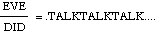
This cryptarithm (or alphametic, as some puzzlists prefer to call them) is an old one of unknown origin, surely one of the best and, I hope, unfamiliar to most readers:
Puzzle #136 Graphic

The same letters stand for the same digits, zero included. The fraction EVE/DID has been reduced to its lowest terms. Its decimal form has a repeating period of four digits. The solution is unique. To solve this, recall that the standard way to obtain the simplest fraction equivalent to a decmal of n repeating digits is to put the repeating digit over n 9’s and reduce the fraction to its lowest terms.

As always, please send your answers as comments within the blog (preferred), or send an e-mail to alokgoyal_2001@yahoo.com. Please do share the puzzle with others if you like, and please also send puzzles that you have come across that you think I can share in this blog.

Happy Talking!
Posted in Puzzles | Tagged , | 4 Comments

Solution to Puzzle #134: Rotating Coins

This was indeed a gem of a puzzle, and the more I have thought about it, the more I like it. Thanks again to Girish Tutakne for sharing this puzzle. I received a few correct answers – Suman Saraf, Prakhar Prakash, Pratik Poddar, Raghu and Abhinav Jain – well done all!

The reason why most people were stumped by this question is that they assume that they assume that the small coin has to traverse the circumference of the bigger coin, which is 2*pi*6. Since the circumference of the smaller coin is 2*pi*2, the answer must be 3.

The best way to try this puzzle is to do this puzzle with two coins of identical size. With he logic above, there should be only one rotation, however, as you will see there are two. The reason is that the rotating coin is rotating in a circle with the radius that is equal to the sum of the radii. Therefore in the case of this puzzle, it is rotating around a circle with the radius 6+2 = 8 cm, and hence needs to rotate 4 times.

Here is a video link that already existed on YouTube for this puzzle.

Hope you all enjoyed the puzzle!


Posted in Solution | Tagged , | Leave a comment

Puzzle #135: Two Dice = Nine Cards

This is a gem of a puzzle from Gurmeet.net, one of my favourite collection of puzzles!

Alice has two standard dice with labels 1 thru 6. When she rolls them and adds their labels, she gets a distribution over integers in [2, 12]. Bob has nine cards, each labeled with some real number. When Bob chooses two cards (without replacement) and adds their labels, he gets exactly the same distribution over integers in [2, 12] as Alice gets by rolling her dice. What are the labels on Bob’s nine cards?

As always, please send your answers as comments within the blog (preferred), or send an e-mail to alokgoyal_2001@yahoo.com. Please do share the puzzle with others if you like, and please also send puzzles that you have come across that you think I can share in this blog.

Happy dicey week to you all!

Posted in Puzzles | Tagged , | 3 Comments

Solution to Puzzle #133: Find the Letters

This was a relatively simple problem and many people sent me the correct solution, that includes – Anisha and Arushi Goyal (together), Piyush Maheshwari, Suman Saraf, Karan Sharma, Manjiri, Arun Kohli and Abhinav Jain. Well done all!

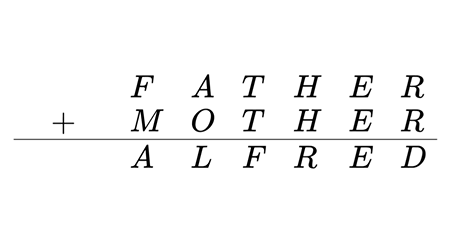
The answer is as follows:

F- 2, A- 8, T- 6, H- 3, E- 9, R- 7, M- 5, O- 1, L- 0, D-4

Therefore the math adds up as follows:

286397+516397=802794

The good thing is that the entire solution can be derived without any trial and error. Here is a video link to solve the puzzle, might be worth sharing with children.

Hope you all enjoyed the solution.


Posted in Solution | Tagged , | Leave a comment

Solution to Puzzle #132: Boys, Girls and Pennies

I got a few correct solutions to the puzzle – Suman Saraf, Manjiri and Karan Sharma. Congratulations to all three!

Answer: Boys count out at interval of 14 and girls count out at interval of 13. Unfortunately, I was hoping that there would be a trick to it, but could not find any specific trick. That said, it is easy to eliminate possibilities quickly counting from the bottom.

Hope you all enjoyed the puzzle.


Posted in Solution | Tagged , | Leave a comment

Puzzle #134: Rotating Coins

This is a gem of a problem pointed to me by an avid puzzler and an IITD friend (now in Philippines) – Girish Tutakne. Thanks Girish. Even though I know the answer, it still baffles me!

Suppose we have 2 coins, with radii 2 cm and 6 cm respectively. The coin with the 2 cm radius is rotated on the circumference of the bigger coin. How many times will it rotate before it comes back to it’s starting point?

As always, please send your answers as comments within the blog (preferred), or send an e-mail to alokgoyal_2001@yahoo.com. Please do share the puzzle with others if you like, and please also send puzzles that you have come across that you think I can share in this blog.

Happy circling!

Posted in Puzzles | Tagged , | 9 Comments

Puzzle #133: Find the Letters

This is a cute problem, a relatively easy one, from Brilliant.org. For those of you who have stopped sharing the puzzles with children, might be a good idea to share this one, I think most kids can do this with some trial and error.

Each letter is a unique digit, and L is 0 (zero)

Puzzle #133 Graphic

Puzzle #133 Graphic

Find all the letters.

As always, please send your answers as comments within the blog (preferred), or send an e-mail to alokgoyal_2001@yahoo.com. Please do share the puzzle with others if you like, and please also send puzzles that you have come across that you think I can share in this blog.

Happy lettering!

Posted in Puzzles | Tagged , | 9 Comments

Solution to Puzzle #131: The Pyramid Problem

This was a ver unintuitive problem, and thanks again to my nephew Karan Sharma on sending this problem. People who sent the correct answers included Abhinav Jain, Pratik Poddar and Suman Saraf.

The answer is 5. It is kind of difficult to explain in words, one needs to see in 3-D, and hence pointing people to a video that shows the answer.


Hope you all enjoyed the puzzle!


Posted in Solution | Tagged , | Leave a comment

Puzzle #132: Boys, Girls and Pennies

This is a very nice puzzle borrowed from Alok Mittal’s Mathematical Circles class.

Five boys and five girls found five pennies. It was decided to arrange the group in circle, and count out individuals at fixed intervals, giving them a penny as they leave. A clever boy came up with a scheme to arrange the kids in the circle so that all the boys would count out first. The girl standing at the first place, though, insisted that she be allowed to determine the interval, and arranged it so that all girls got counted out first. The arrangement in the circle was as under (Start at 1, and go clockwise). What were the intervals the boy and the girl thought of?

Puzzle #132 Graphic

Puzzle #132 Graphic

As always, please send your answers as comments within the blog (preferred), or send an e-mail to alokgoyal_2001@yahoo.com. Please do share the puzzle with others if you like, and please also send puzzles that you have come across that you think I can share in this blog.

Happy penny pinching!

Posted in Puzzles | Tagged , | 2 Comments

Solution to Puzzle #130: The Plato Riddle

Thanks again to Sirisha for this wonderful puzzle. As I mentioned this was more of a teaser, and a play with words more than math. I only got two correct answers – One from Girish Tutakne and another from Vikas Jangra – well done both!

If you read the puzzle again, pay attention to the following:

  • Read every “a” as a variable a
  • Read every “be” and “bee” as a variable b
  • Circle stands for ‘0” (the number zero)
  • combine means + i.e. addition
  • a^2 is not 0 and b^2 is not 0 => neither a nor b are zero
  • If you read carefully, the answer is given in “one negativity” which stands for “-1

Putting all of this together (copying the answer from Girish Tutakne)

Any combination of a and b where a*b = -1 is the answer.

a^2.b^2 + a^3.b^3 = 0
a, b both not equal to 0.

a^2.b^2.(1+a.b) = 0
Hence, a*b = -1

Hope you all enjoyed the puzzle!

Posted in Solution | Tagged | Leave a comment