Puzzle #121: Spider and The Fly

This is a puzzle whose variations many people would have done already. Yet, I found this to be very nice and not as simple as it may seem at first sight. I picked this from a Martin Garder book again “More Mathematical Puzzles and Diversions”. This specific puzzle is attributable to Henry Ernest Dudley, regarded as one of England’s greatest inventor of puzzles. This particular puzzle first appeared in a newspaper in 1903.

Look at the figure below. The spider is at the middle of an end wall, one foot from the ceiling and . The fly is at the middle of the opposite end wall, one foot above the floor and too paralysed with fear to move. What is the shortest distance the spider must crawl in order to reach the fly?

Figure: Puzzle 121

Figure: Puzzle 121

As always, please send your answers as comments within the blog (preferred), or send an e-mail to alokgoyal_2001@yahoo.com. Please do share the puzzle with others if you like, and please also send puzzles that you have come across that you think I can share in this blog.

Happy crawling and a Happy Diwali!

Posted in Puzzles | Tagged , | 3 Comments

Solution to Puzzle #119: A Prime Cryptarithm

This was a slightly difficult problem for many people, though can be solved with some persistent trial and error. Girish Tutakne, Pradeep Hengavelli, Suman Saraf, Chandu Karan and Pooja Goyal+Arushi Goyal were the ones to send correct answers.

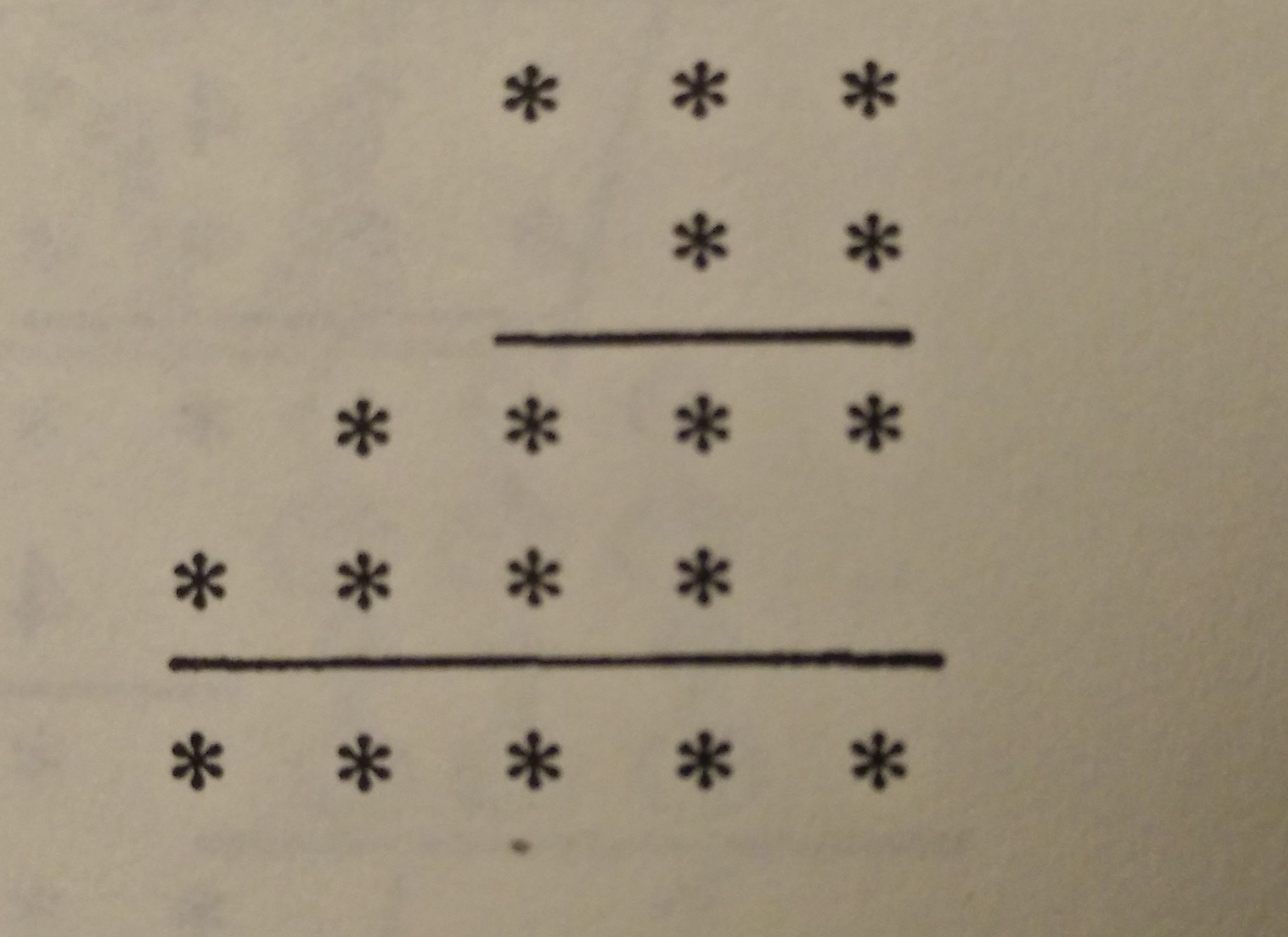
I do not know if there is an elegant solution to this, requires trial and error. The solution is

Puzzle 119 Answer

Puzzle 119 Answer

The only trick one can think of is that the last digit of the two numbers cannot be “2” as the  multiplication will yield an even number as the last digit. Similarly, the last digits cannot be 3,3 or 7,7 or 7,3 as they yield 9, 9 and 1 respectively as the last digit. Therefore the combinations can be 5,5; 7,5 and 3,5. Beginning with these assumptions, one can build upon the different possibilities and rule them out gradually.

Hope you all enjoyed the puzzle!


Posted in Solution | Tagged , | Leave a comment

Puzzle #120: The Efficient Electrician

This is a gem of a puzzle – read it this morning in the book Mathematical Puzzles and Diversions by Martin Gardner. I have had many of the Martin Gardner books for ages now, but overtime I open these books, I continue to find hidden treasures there!

An electrician is faced with this annoying dilemma. In the basement of a three-storey house, he finds bunched together in a  hole in the wall the exposed ends of 11 wires, all alike. In a hole in the wall on the top floor, he finds the other ends of the same 11 wires, but he has no way of knowing which end above belongs to which end below. His problem: to match ends.

To accomplish his task, he can do two things:

  1. Short circuit the wires at either spot by twisting the ends together in any manner he wishes
  2. test for a closed circuit by means of a “continuity tester” consisting of a battery and a bell. The bell rings when the instrument is applied to the two ends of a continuous, unbroken circuit.

Not wishing to exhaust himself by needless stair climbing, and having a passionate interest in solving puzzles (like all of you!), the electrician sat down on the top floor with a pencil and paper and soon devised the most efficient possible method of labelling the wires.

What was the method?

As always, please send your answers as comments within the blog (preferred), or send an e-mail to alokgoyal_2001@yahoo.com. Please do share the puzzle with others if you like, and please also send puzzles that you have come across that you think I can share in this blog.

Happy circuiting!

Posted in Puzzles | Tagged , | 2 Comments

Solution to Puzzle #118: Rotating Disk

This was a slightly difficult puzzle, and I got relatively few correct solutions. From Alok’s Mathematical Circles class, I know that several people were able to get the answer, that included Smiti Mittal (had a very innovative and simple answer) and Anisha Goyal. Other people to send the correct answer included Suman Saraf (complete answer), Chandu Karan and Umesh Mayekar. Well done all!

I am reproducing multiple answers, the one from Alok’s class I found to be the most complete is the following:

A,B,C,D,E,F have 15,14,13,10,11,12 respectively

Opposite sitting players total at end of 5 games must be 25 for each pair. So A must have at least 14 (because someone in other pairs must have at least 13). This means D can have at most 11, and he already has 9 in first two rounds. So D must have a zero in some round. Since order of rounds is not important, lets say D has a zero in 3rd round. On last two rounds, D’s possibilities (given he can only score 2 more points) are 00, 01, 11, or 02. We can test each of these in turn.

One from Smiti, which I also liked very much ( though I am not able to conclude from this answer that this is the only possibility):

Smiti had a great solution. Once it is clear that D must have 5 in the second round, she just flipped the scores for 3rd and 4th rounds relative to 1st and 2nd round. This brought everyone to a score of 10. Then simply get A a 5 in the last round

Hope you all enjoyed the puzzle!

Posted in Solution | Tagged , | Leave a comment

Puzzle #119: A Prime Cryptarithm

This is a wonderful puzzle taken from the book “The Moscow Puzzles” by Boris A. Kordemsky. This book has a great collection of puzzles.

In this remarkable puzzle, each digit is a prime (2, 3, 5 or 7). No letters or digits are provided as clues, but there is only one solution. Find each of the digits in the multiplication below.

IMG_20151025_194607 (1)

As always, please send your answers as comments within the blog (preferred), or send an e-mail to alokgoyal_2001@yahoo.com. Please do share the puzzle with others if you like, and please also send puzzles that you have come across that you think I can share in this blog.

Happy cryptic days!

Posted in Puzzles | Tagged , | 3 Comments

Solution to Puzzle #117: Mr. Calendar

Apologies for not posting last weekend, I was traveling on a short vacation!

This was a relatively easy puzzle, many people sent me the correct answer. Folks who sent me the correct answer include Karan Sharma, Suman Saraf, Sanjeev Dugar, Anirudh Baddepudi, Girish Tutakne, Sri Peddu, Sandeep Verma, Alok Kuchlous, Prakhar, Alankrita Agrawal, Praneeth, Chandu Karan, Pratik Poddar and Rahul Garg – Well done all!

The answer is Feb 28, 29, March 1, 2 and 3 – therefore this is possible only in a leap year.

For any five contiguous numbers, the sum is divisible by 5. Since 63 is not, it can only mean that there is a cut off at the end of the month in the sequence of 5 dates. Since all months end between 28 and 31, we can figure out by simple trial and error that there need to be two dates at the end of the month followed by 1, 2 and 3 of the following month. This implies that the two dates need to add up to 57, which again implies that the dates can only be 28th and 29th, and hence Feb 28 and 29th of a leap year.

Hope you all enjoyed the puzzle!

Posted in Solution | Tagged , | Leave a comment

Puzzle #118: Rotating Disk

Taking another puzzle from Alok Mittal’s class – another beautiful puzzle!

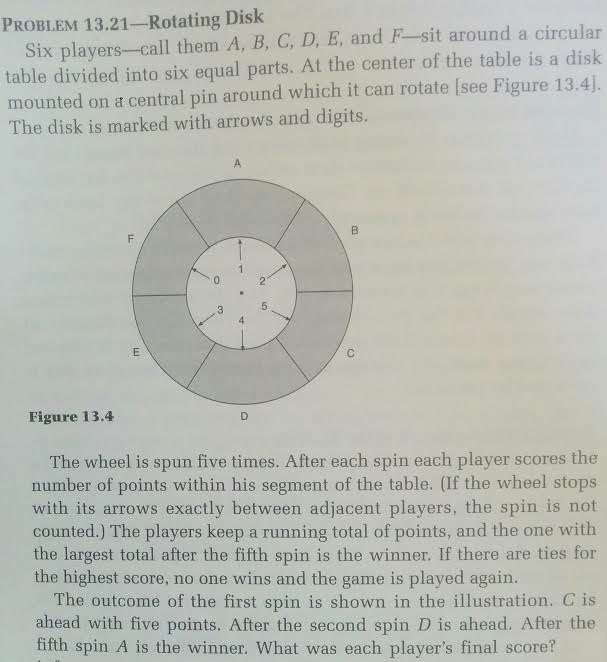
Look at the graphic below. While the graphic contains the entire puzzle, am repeating it here:

Six players – call them A, B, C, D, E and F – all around a circular table divided into six equal parts. At the centre of the table is a disk mounted on a central pin around which it can rotate. The disk is marked with arrows and digits.

The wheel is spun 5 times. After each spin each player scores the number of points within his/ her segment of the table. If the wheel stops with its arrows exactly between adjacent players, the spin is not account and hence repeated. The players keep a running total of points, and the one with the largest total after the 5th spin is the winner. If there are ties of the highest score, no one wins and the game is played again.

The outcome of the first spin is shown in the illustration. C is ahead with 5 points. After the 2nd spin, D is ahead. After the 5th spin, A is the winner. What was each player’s final score.

Puzzle 118 Graphic

Puzzle 118 Graphic

As always, please send your answers as comments within the blog (preferred), or send an e-mail to alokgoyal_2001@yahoo.com. Please do share the puzzle with others if you like, and please also send puzzles that you have come across that you think I can share in this blog.

Happy gambling!

Posted in Puzzles | Tagged , | 2 Comments

Solution to Puzzle #116: The Magic Card Frame

I got many correct answers for this puzzle as well and a very good response. People who sent correct answers included Chandu Karan, Divya, Suman Saraf (The most complete solution) and Pratik Poddar. I am reproducing the solutions from Suman, done both by common logic and later set of all solutions generated from a computer script (I tried to clean them up for duplicates, but too many to do so :-()

Since we know the 4 corners will be counted twice, it means 55 (sum 1..10) + 4 corners should be a multiple of 4 since all sides all add up to the same sum. The sum of the corners could range between 10 (1,2,3,4 in the corners) to 34 (7,8,9,10) in the corners. This leaves us with the following options:

sum of sides | sum of corners

17 (*4 = 68) | 13
18 (*4 = 72) | 17
19 (*4 = 76) | 21
20 (*4 = 80) | 25
21 (*4 = 84) | 29
22 (*4 = 88) | 33

Using this option we can try and fill the frame. The last one is the simplest because there is only one combination that could fill the corners (i.e. sum of corners is 33) – 6,8,9,10. Using this we could fill it up in the following way:

6 7 9
5 3
1 2
10 4 8

Obviously a few transforms of this arrangement will also suffice.

Similarly, one can find solutions for sums = 18, 19 and 20

1 9 8
4 3
7 5
6 10 2

1 8 10
5 2
6 4
7 9 3

2 8 10
3 1
6 5
9 7 4

Exhaustive list of solutions:

results in:

sum(19)
1 8 10
5 2
6 4
7 9 3

sum(19)
1 8 10
5 2
7 3
6 9 4

sum(18)
1 9 8
4 3
7 5
6 10 2

sum(19)
1 10 8
4 2
5 6
9 7 3

sum(20)
2 8 10
3 1
6 5
9 7 4

sum(18)
2 10 6
3 1
8 7
5 9 4

sum(19)
3 9 7
1 2
10 4
5 8 6

sum(20)
3 9 8
2 1
5 7
10 6 4

sum(22)
6 7 9
1 2
5 3
10 4 8

sum(20)
8 9 3
1 2
7 5
4 6 10

sum(20)
8 9 3
1 5
7 2
4 6 10

sum(20)
8 9 3
7 2
1 5
4 6 10

sum(20)
8 9 3
7 5
1 2
4 6 10

sum(19)
8 10 1
2 4
6 5
3 7 9

sum(19)
8 10 1
2 5
6 4
3 7 9

sum(19)
8 10 1
6 4
2 5
3 7 9

sum(19)
8 10 1
6 5
2 4
3 7 9

sum(19)
9 7 3
4 2
5 6
1 10 8

sum(19)
9 7 3
4 6
5 2
1 10 8

sum(19)
9 7 3
5 2
4 6
1 10 8

sum(19)
9 7 3
5 6
4 2
1 10 8

sum(20)
9 7 4
3 1
6 5
2 8 10

sum(20)
9 7 4
3 5
6 1
2 8 10

sum(20)
9 7 4
6 1
3 5
2 8 10

sum(20)
9 7 4
6 5
3 1
2 8 10

sum(22)
9 7 6
1 3
2 5
10 4 8

sum(22)
9 7 6
1 5
2 3
10 4 8

sum(22)
9 7 6
2 1
3 5
8 4 10

sum(22)
9 7 6
2 3
1 5
10 4 8

sum(22)
9 7 6
2 5
1 3
10 4 8

sum(22)
9 7 6
2 5
3 1
8 4 10

sum(22)
9 7 6
3 1
2 5
8 4 10

sum(22)
9 7 6
3 5
2 1
8 4 10

sum(22)
10 4 8
1 2
5 3
6 7 9

sum(22)
10 4 8
1 3
2 5
9 7 6

sum(22)
10 4 8
1 3
5 2
6 7 9

sum(22)
10 4 8
1 5
2 3
9 7 6

sum(22)
10 4 8
2 3
1 5
9 7 6

sum(22)
10 4 8
2 5
1 3
9 7 6

sum(22)
10 4 8
5 2
1 3
6 7 9

sum(22)
10 4 8
5 3
1 2
6 7 9

sum(20)
10 6 4
2 1
5 7
3 9 8

sum(20)
10 6 4
2 7
5 1
3 9 8

sum(20)
10 6 4
5 1
2 7
3 9 8

sum(20)
10 6 4
5 7
2 1
3 9 8

sum(19)
10 8 1
2 5
3 7
4 9 6

sum(19)
10 8 1
2 5
4 6
3 9 7

sum(19)
10 8 1
2 6
4 5
3 9 7

sum(19)
10 8 1
2 7
3 5
4 9 6

sum(19)
10 8 1
3 5
2 7
4 9 6

sum(19)
10 8 1
3 7
2 5
4 9 6

sum(19)
10 8 1
4 5
2 6
3 9 7

sum(19)
10 8 1
4 6
2 5
3 9 7

sum(20)
10 8 2
1 3
5 6
4 7 9

sum(20)
10 8 2
1 6
5 3
4 7 9

sum(20)
10 8 2
5 3
1 6
4 7 9

sum(20)
10 8 2
5 6
1 3
4 7 9

Hope you all enjoyed the puzzle!

Posted in Solution | Tagged , | Leave a comment

Puzzle #117: Mr. Calendar

This is a beautiful brain teaser that my wife, Pooja, asked me a few days back just before we were going to sleep – yes this was our pillow talk 🙂

Mr. Calendar spends a sum equal to the date (of that day) every day. For example, on 17th (regardless of the month), he will spend 17 Rupees, on 21st, he will spend 21 Rupees and on 7th , he will spend 7 Rupees. On 5 consecutive days, he collectively spends Rupees 63. What dates were these?

As always, please send your answers as comments within the blog (preferred), or send an e-mail to alokgoyal_2001@yahoo.com. Please do share the puzzle with others if you like, and please also send puzzles that you have come across that you think I can share in this blog.

Happy Calendering!

Posted in Puzzles | Tagged , | 5 Comments

Solution to Puzzle #115: The First Rabbit

Thanks for an overwhelming response again to the rabbit puzzle. Anyone who responded, did so with the correct answer! Some people did not send any explanation, amongst those who did, I like the simplicity of the answer from Prakhar, Salil Panikkaveenttil and Suman Saraf. Others to send the answers included Anshul, Suhars Praneeth Kumar, Pradeep Malviya, Garima Rai, Chandu Karan and Puzzleduniya. Well done all, and thank you Anisha for asking me this puzzle.

The answer is spotted. We know that no matter who reproduces, each reproduction creates an equal number of grays and whites. If the first rabbit was either gray or white, then the difference in number of gray and white rabbits will be 1, whereas we know that they are equal. Hence the first rabbit can only be Spotted.

Hope you all enjoyed the puzzle!

Posted in Solution | Tagged , | Leave a comment