Solution to Puzzle #105: The 150 Year Old Puzzle

This was indeed a more difficult puzzle than it appeared and for a change I did not get any correct solution. One realises that after trying a few combinations for the first 2-3 days, one invariably gets stuck in a hole. This puzzle had gone viral after it was first published, partially just due to its simplicity.

Here is one of the answers to the puzzle, the original source claims that there are seven solutions.

It turns out that there are essentially seven different solutions to Kirkman’s original schoolgirl problem; here’s one of them (All names of course are made up).

Monday:
Annabel-­‐‑Bertha-­‐‑Clarissa
Dora-­‐‑Ermengarde-­‐‑Fanny
Gertrude-­‐‑Harriet-­‐‑Irene
Josephine-­‐‑Katie-­‐‑Louisa
Mabel-­‐‑Nettie-­‐‑Olive

Tuesday:
Annabel-­‐‑Dora-­‐‑Gertrude
Bertha-­‐‑Ermengarde-­‐‑Harriet
Clarissa-­‐‑Louisa-­‐‑Olive
Fanny-­‐‑Josephine-­‐‑Nettie
Irene-­‐‑Katie-­‐‑Mabel

Wednesday:
Annabel-­‐‑Josephine-­‐‑Mabel
Bertha-­‐‑Katie-­‐‑Nettie
Clarissa-­‐‑Fanny-­‐‑Irene
Dora-­‐‑Harriet-­‐‑Louisa
Ermengarde-­‐‑Gertrude-­‐‑Olive

Thursday:
Annabel-­‐‑Ermengarde-­‐‑Katie
Bertha-­‐‑Fanny-­‐‑Louisa
Clarissa-­‐‑Gertrude-­‐‑Mabel
Dora-­‐‑Irene-­‐‑Nettie
Harriet-­‐‑Josephine-­‐‑Olive

Friday:
Annabel-­‐‑Harriet-­‐‑Nettie
Bertha-­‐‑Irene-­‐‑Olive
Clarissa-­‐‑Dora-­‐‑Josephine
Fanny-­‐‑Gertrude-­‐‑Katie
Ermengarde-­‐‑Louisa-­‐‑Mabel

Saturday:
Annabel-­‐‑Fanny-­‐‑Olive
Bertha-­‐‑Dora-­‐‑Mabel
Clarissa-­‐‑Harriet-­‐‑Katie
Ermengarde-­‐‑Irene-­‐‑Josephine
Gertrude-­‐‑Louisa-­‐‑Nettie

Sunday:
Annabel-­‐‑Irene-­‐‑Louisa
Bertha-­‐‑Gertrude-­‐‑Josephine
Clarissa-­‐‑Ermengarde-­‐‑Nettie
Fanny-­‐‑Harriet-­‐‑Mabel
Dora-­‐‑Katie-­‐‑Olive

For the avid puzzlers/ mathematicians, one can see that there can be a more generic version of this puzzle where there are n ladies, who go out in pairs of m each (n is divisible by m) and do this for d days. If you are interested, please refer to the following link:

http://www.wired.com/2015/06/answer-150-year-old-math-conundrum-brings-mystery/

Hope that some of you tried this and enjoyed it!
Posted in Solution | Tagged , | Leave a comment

Puzzle #105: 150 Year Old Puzzle

This is truly an old puzzle. I was sent this one by Salik Shah (thank you Salik). It appeared in the WIRED magazine. I am reproducing the puzzle verbatim as I saw it in WIRED:

IN 1850, THE Reverend Thomas Kirkman, rector of the parish of Croft-with-Southworth in Lancashire, England, posed an innocent-looking puzzle in the Lady’s and Gentleman’s Diary, a recreational mathematics journal:

“Fifteen young ladies in a school walk out three abreast for seven days in succession: it is required to arrange them daily, so that no two shall walk twice abreast.” (By “abreast,” Kirkman meant “in a group,” so the girls are walking out in groups of three, and each pair of girls should be in the same group just once.)

Caution: The problem is more difficult than it seems!

Please send your answers either directly on the blog site as comments, or to me at alokgoyal_2001@yahoo.com. If you like the puzzle, please share it with others. If you have interesting puzzles to share, please send them to me at my e-mail given above.

Happy school walks!

Posted in Puzzles | Tagged , | Leave a comment

Solution to Puzzle #104: Togglers Puzzle

Apologies for an inordinate delay in posting the answer to this puzzle. I was on vacation with children over the last 3 weekends 🙂

This was a very interesting, though a slightly difficult puzzle. I got 4 correct answers from Akshay Joshi, Jyotsana Dube, Maneesh Dube and Suman Saraf – congratulations! Answers from everyone were the same, I am reproducing the answer from Maneesh Dube, who captured it most succinctly.

The first question is going to be-“are you a toggler?”. There are two possible answers that the person can give:

1. If answer was a “No”, then you know that your next answer will be true (no matter who you ask). Your next question will be-“who is the truth teller?”

2. If answer is “Yes”, then you know that it is a toggler because the truth teller will say no. You know that your next answer will be a lie. So your next question will be-“who are not the truth tellers?”

Akshay, also added a note in his answer with a link to another source which is a similar puzzle, please do check it out.

“I think you should checkout the Knight and Knaves
puzzle by Smullyan (and its numerous variants) which is similar to
this puzzle. (Link attached)
http://en.wikipedia.org/wiki/Knights_and_Knaves

Hope you all enjoyed the puzzle!

Posted in Solution | Tagged , , | Leave a comment

Puzzle #104: Togglers Puzzle

Another beautiful puzzle this time – one from my nephew Karan Sharma, originally seen from Khan Academy, though available at other places as well. This is a truth-liar problem. Here it goes:

You are in a room with five people. One of them will always tell you the truth. The other four will toggle between telling you the truth, and lying to you. However they can either tell you the truth OR lie on the first question you ask them. After that they must always toggle between that and the opposite. For example. I see one has a mustache, and he is a toggler. I ask – “Do you have a mustache?” “Yes.” I ask again. “No.” I ask again. “Yes.” OR I ask – “Do you have a mustache?” “No.” I ask again. “Yes.” I ask again. “No.” The challenge of the riddle is to ask exactly TWO questions to anyone. You can ask both questions to the same person or ask questions to two different people, and at the end of your two questions you must find out who the truth-teller is.

Please send your answers either directly on the blog site as comments, or to me at alokgoyal_2001@yahoo.com. If you like the puzzle, please share it with others. If you have interesting puzzles to share, please send them to me at my e-mail given above.

Be truthful!

Posted in Puzzles | Tagged , | Leave a comment

Solution to Puzzle #103: Proof Without Trigonometry

A wonderful puzzle, and the solution is a beautiful one. This was a difficult one, and therefore I did not get as many answers to the puzzle. Abhinav was the first one to send a correct answer – and a correct one, same as the original method. Suman Saraf sent an alternative answer, again a correct one. I got two more answers but they used trigonometry, and hence not reproducing them here.

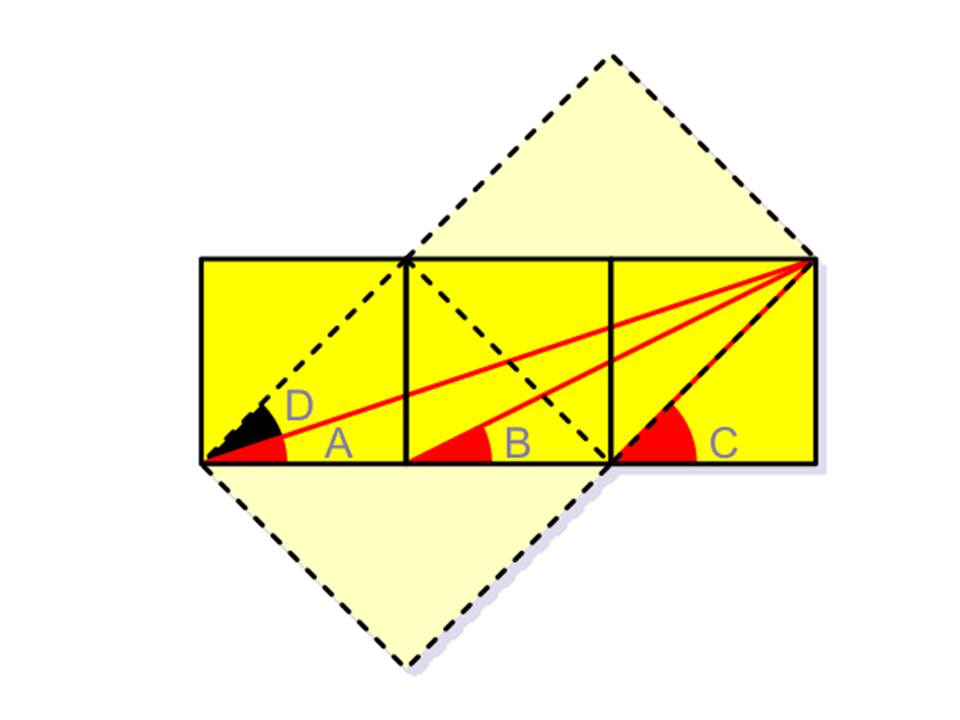
Here is the answer as stated in the original solution, which I have picked up from The Guardian. Look at the figure below.

Puzzle 103 Solution

Puzzle 103 Solution

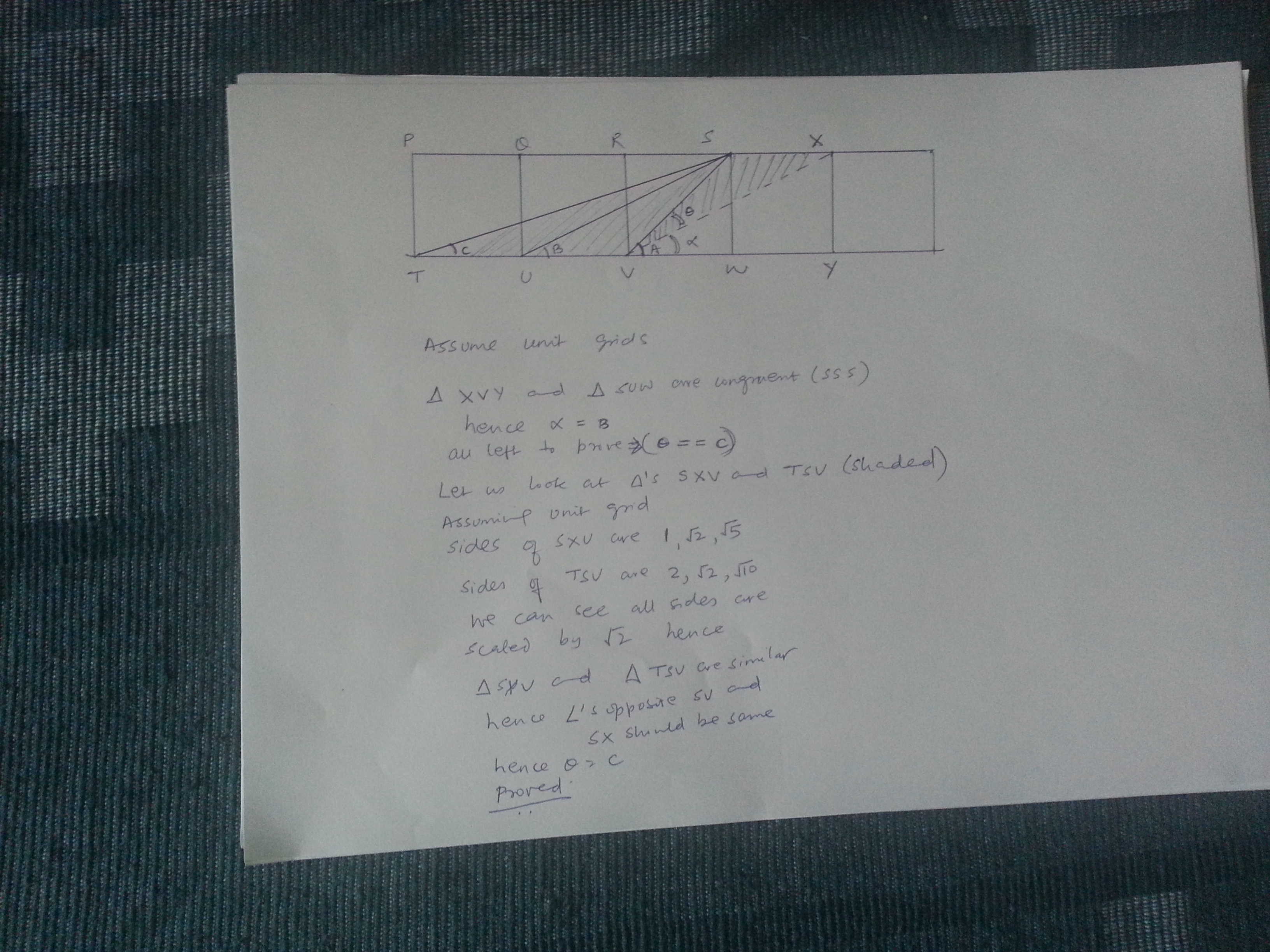
Let’s construct the additional squares indicated by dotted lines. It is clear from the illustration that angle C is the sum of angles A and D. Angle B equals angle D because they are corresponding angles of similar right triangles (with the respective legs in the 1:2 proportion). That means B can be substituted for D, which automatically makes the C equals the sum of A and B.

Suman sent a similar answer, which is that he extended the graphic, but in a different way and did not use trigonometry. Very well done. Reproducing the answer as sent by Suman in the figure below:

Suman Saraf Puzzle 103 Solution

Suman Saraf Puzzle 103 Solution

Hope you all enjoyed the puzzle!


Posted in Solution | Tagged , | Leave a comment

Puzzle #103: Proof Without Trigonometry

This is a wonderful puzzle I found in the puzzle collection of The Guardian newspaper, the original source being Martin Gardner. The beauty of this puzzle is that one needs to use simple rules of geometry and we do not need any trigonometry at all.

Illustration for Puzzle #103

Illustration for Puzzle #103


Please have a look at the figure above. Prove that angle C in the illustration equals the sum of angles A and B.

Please send your answers either directly on the blog site as comments, or to me at alokgoyal_2001@yahoo.com. If you like the puzzle, please share it with others. If you have interesting puzzles to share, please send them to me at my e-mail given above.

Happy angling!


Posted in Puzzles | Tagged , | 1 Comment

Solution to Puzzle #102: The Persistence Problem

This was a difficult puzzle, though I continue to be amazed how so many people solve them with such speed…my hats off to all the ones who solved this one. That includes Saurabh Aggarwal, Abhinav Jain, Akshay Joshi, Suman Saraf and Amit Mittal.

I could not find any good method to find the answer, though the answer is 679. the sequence goes as follows:

679-378-168-48-32-6

I do not have any proof that this is indeed the smallest way of doing this. I do not know which of the Martin Gardner books this is from, once I find, I will make another post on this.

Thanks to Amit Mittal who gave the most elaborate answer, I am reproducing this here (though I do not fully understand the first part of his answer):

Congratulations for being able to carry on with kth powers of prime numbers in digits. The easiest persistent number with persistence as k is usually a series of numbers with k in the digit and the series of 1s in the digits from 1 1 to n 1s

e.g.

1

2 12 21 121 112

3 13 31 113 131 311

5 15 51 115 511

Our answer as is widely available has a persistence digital root of 6

further traversing up to discover the method of the madness

6 – 32 and the roots of 32 are 22222 or 48

6-32-48 we can pad 1 to get 148 or ( from an admitted hindsight bias) 168

roots of 148 (factors) are 74*2 or 37*4 which goes nowhere in constructing the number as we see below we can get the same 148 from 168 which uses the 7 prime factor to up the product persistence

while roots of 168 are 21*8 or 378

we now have

6-32-48-168-378

the roots of 378 are 189*2 or 3*3*3 * 7 * 2 that gives us 6 * 7 * 9

which gives us 679 which is probably the smallest as we use a lot of 2s in here.

I do know to construct numbers with persistence of 1, 2, 3, 4, 5 is harder even knowing you can arrange prime factors of the number

237 or 732 give the same persistence of two 732-42-8

Thus the smallest number with persistence of n will be arranged in increasing order of digits or like 77 have the same digits

679 – 378 – 168 – 48 – 32 – 6

Hope you all enjoyed the puzzle!

Posted in Solution | Tagged , | Leave a comment

Puzzle #102: The Persistence Puzzle

This is yet another famous puzzle from the Martin Gardner collection. I was made aware of this one by my nephew, Karan Sharma – thank you! I have not looked up the answer to this one, so do not know how easy or difficult the solution is, but I look forward to doing it myself and also seeing the answers from many of you.

A number’s persistence is the number of steps required to reduce it to a single digit by multiplying all its digits to obtain a second number, then multiplying all the digits of that number to obtain a third number, and so on until a one-digit number is obtained. For example, 77 has a persistence of four because it requires four steps to reduce it to one digit: 77-49-36-18-8. The smallest number of persistence one is 10, the smallest of persistence two is 25, the smallest of persistence three is 39, and the smaller of persistence four is 77. What is the smallest number of persistence five?

As always, please send your answers directly to me at alokgoyal_2001@yahoo.com. If you like the puzzle, please share it with others. If you have interesting puzzles to share, please send them to me at my e-mail given above.


Be persistent with this puzzle 🙂


Posted in Puzzles | Tagged , | Leave a comment

Solution to Puzzle #101: Shortest Path Touching the X-axis

Thanks to Arunima and Amol again for contributing a wonderful puzzle. This is a famous puzzle called the Heron’s Shortest Distance Problem and has historical roots. The puzzle can be solved through calculus, but can be solved without any calculus as well, and that is the attempt taken here.

There were three correct answers to the puzzle – Karan Sharma, my nephew form Jaipur, Abhinav Jain (last week’s prize puzzle winner) and Suman Saraf, who has been sending the right answers to just about every puzzle – thank you all and well done!

I have attached the solution through a video this time to explain the answer:

More interested readers can also look up a more in depth treatment on the following link that was originally shared by Arunima.

http://www.maa.org/publications/periodicals/convergence/historical-activities-for-calculus-module-3-optimization-herons-shortest-distance-problem

Hope you enjoyed this puzzle!


Posted in Solution | Tagged , | 1 Comment

Puzzle #101: Shortest Path Touching the X-Axis…

This is a beautiful puzzle initially sent to me a month back by Arunima, a friend from IIT Delhi now in Washington DC. The same puzzle was sent to me by another friend’s son, Amol Aggarwal, now doing his PhD in Math from Harvard. No, you do not need to be a PhD to solve this one though, so do not get scared 🙂

Puzzle 101 Graphic

Puzzle 101 Graphic

Please take a look at the figure above. This is drawn on a standard 2-dimensional grid with an x-axis and a y-axis. There are two points A and B at location (0,1) and (5,11) respectively. Your task is to find a point C on the x-axis such that AC+BC is the shortest.

As always, please send your answers directly to me at alokgoyal_2001@yahoo.com. If you like the puzzle, please share it with others. If you have interesting puzzles to share, please send them to me at my e-mail given above.


Happy path finding!


Posted in Puzzles | Tagged , | Leave a comment