Solution to Puzzle #40: White-Tailed Cats

Two children sent me correct answers this time. Like last time, Shruti Mittal (from Mumbai) was the first one to send me a correct answer, and Danny Mittal (from Virginia, USA) also sent me a correct answer. Very well done!

The actual answer requires one to get into a bit of algebra and combinatorial mathematics, the intent of the puzzle was for people to solve this more intuitively. Key to solving was the following:

– If you have c cats, then the number of ways in which you can select 2 cats is c * (c-1)

– If w are white tailed, then the number of ways in which one can select two white tailed cats are w * (w-1)

Since we are looking for a chance of 1/2 for selecting both white tailed cats, quick intuitive thought process will lead to the answer of a total of 4 cats, with 3 of them being white tailed.

The reason the figure of <=20 was also given in the puzzle was that the next possible answer is #cats = 21, and #white tailed cats = 15, which also has the probability of 1/2 for selecting two white tailed cats at random.

Hope you enjoyed the puzzle!
 

Posted in Solution | Tagged , | Leave a comment

Puzzle #40: White-Tailed Cats

This is another puzzle from the same book as I posted last time – “Professor Stewart’s Cabinet of Mathematical Curiosities”. This puzzle appears on Page #31 of the book.

Here is the puzzle:

‘I see you have got a cat,’ said Ms Jones to Ms Smith. ‘I do like its cute white tail! How many cats do you have?’

‘Not a lot,’ said Ms Smith. ‘Ms Brown next door has twenty, which is a lot more than I’ve got.’

‘You still have not told me how many cats yo have!’

‘Well…let me put it like this. If you chose two distinct cats of mine at random, the probability that both of them have white tails is exactly one-half (1/2).’

‘That does not tell me how many you’ve got!’

‘Oh yes it does.’

How many cats does Ms Smith have – and how many have white tails?

Note: for younger children, please avoid the complication of twenty cats, and let them figure out one answer.

As always, please send your answers directly to alokgoyal_2001@yahoo.com and if you like the puzzle, please share it with others. Also, if you have an interesting puzzle that you would like to be posted, please send it to me directly at alokgoyal_2001@yahoo.com

Happy cat-tailing!

Posted in Puzzles | Tagged , | Leave a comment

Solution to Puzzle #39: Triangle of Cards

I was very happy to see that many more people tried the puzzle this time compared to the last few weeks. The only correct answer I received though this time was from a new visitor – Shruti Mittal, 15 years old, from Mumbai – very well done Shruti.

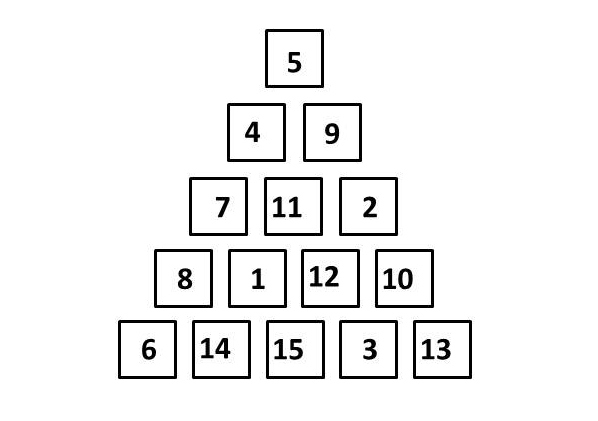
At least for me, this was a trial and error kind of puzzle, with a few rules that help you reduce the number of possibilities. The final answer is as follows:

Solution for Triangle of Cards

Solution for Triangle of Cards

A full approach for solving this through trial and error is also on the video link below:

Hope you enjoyed the puzzle!

Posted in Solution | Tagged , | Leave a comment

Puzzle #39: Triangle of Cards

I was gifted a new puzzle and math book by a friend today – Professor Stewart’s Cabinet of Mathematical Curiosities. This is a puzzle from this book, appearing on Page #6. Thanks Shalu for the book.

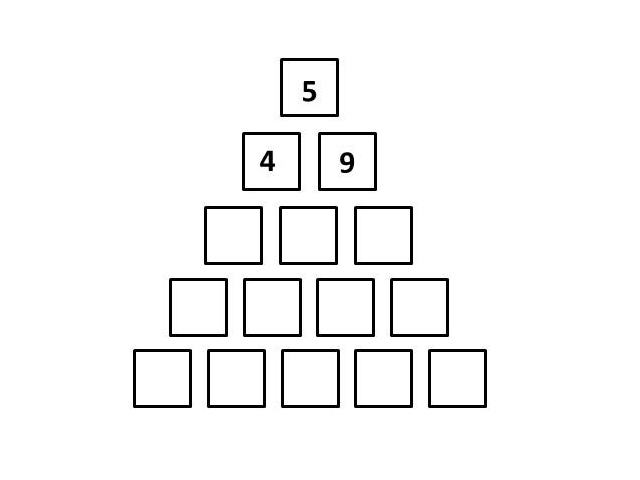
I have 15 cards, numbered consecutively from 1 to 15. I want to lay them out in a triangle. I’ve put numbers on top three for the later reference:

Puzzle 39: Triangle of Cards

Puzzle 39: Triangle of Cards

However, I do not want any old arrangement. I want each card to be the difference between the two cards immediately below it, to left and right. For example, 5 is the difference between 4 and 9. The differences are always calculated so that they are positive. This condition does not apply to the cards in the bottom row, you appreciate.

The top three cards are already in place – and correct. Can you find how to place the remaining 12 cards?

Hint: For younger children, try the same with fewer rows (and corresponding numbers) – try with three rows or four rows as well.

Happy triangulating!


Posted in Puzzles | Tagged , | Leave a comment

Solution to Puzzle #38: Famous Handshake Puzzle

I got only one correct answer for the puzzle, from Anku Jain – Well done and thanks! Anku’s answer was better explained than the source itself, and hence taking the liberty of reproducing his answer verbatim here.

Assuming, no one follows a religion where polygamy is allowed , the answer could be as follows: There are 9 people excluding the guy asking the question as there are a total of 5 couples.The max any person can shake hands with is 8. So, the 9 people shake hands with 0,1,2 … 8 people since all of them gave different answers. For the person who shook hands with 8 people, it means all those 8 people had shaken hand at least once. So, the only person left who could have shaken 0 hands is his/her spouse. Going by the same logic, for the person who shook 7 hands, the spouse would have shaken 1 hands and so on. The other couples would be 6/2 and 5/3. So, only answer 4 is left. That’s the number of handshakes the questioner’s wife shaked..

Hope you all enjoyed the puzzle!


Posted in Solution | Tagged , | Leave a comment

Puzzle #38: Famous Handshake Puzzle

This one is one of my favorites from the Martin Gardner collection:

My wife and I recently attended a party at which there were four other married couples. Various handshakes took place. No one shook hands with himself or herself or with his or her spouse, and no one shook hands with the same person more than once. After all the handshakes were over, I asked each person, including my wife, how many hands he or she had shaken. To my surprise each gave a different answer. How many hands did my wife shake? 

Happy hand and mind shaking!

Posted in Puzzles | Tagged , | Leave a comment

Solution to Puzzle #37: Four 9’s and 100

I surprisingly got fewer answers than I expected. The most noteworthy response was from Ruchir Godura, who rattled a whole set of possibilities. I cannot prove that this is the exhaustive list, but here are the ones I have come across – 6 of them:

99 + (9/9)

99 + (.9/.9)

(9 + (9 * 9))/ .9

(99 – 9) / .9

(9/.9)*(9/.9) (and many other permutations of the same answer exist)

(99/.99)

Hope you enjoyed the puzzle!


Posted in Solution | Tagged , | Leave a comment

Puzzle #37: Four 9’s and 100

This one is a relatively easy one and something that can be attempted by folks of all age groups. I picked it up on the internet from the following site: http://www.puzzles2puzzleu.com/

You have four 9’s and you may use any of the (+, -, /, *,.) as many times as you like.

Can you make an expression which gives a result of 100 by using four 9s and any arithmetic operators? If yes how many such expressions can you make?

As always, please send your answers to alokgoyal_2001@yahoo.com and if you like the puzzle, please share it with others.

Happy number crunching!


Posted in Puzzles | Tagged , | 1 Comment

Solution to Puzzle #36: Professor on the Escalator

This one turned out to be a little difficult for children who do not know algebra, and hence I did not get correct answer from any of the younger kids. Congratulations to Ruchir Godura and Varun Gupta for being the first ones to send the right answer.

I have attempted to explain the answer without algebra for younger children, though I must confess that it is not easy.

For folks who know algebra, I am reproducing the answer sent by Varun:

Assume the staircase to be x. While coming down- Man took 50 steps, in the same time lift came down x-50 steps.

While going up man took 125 steps, lift came down by 125- x steps.

As man ran 5 times as fast as coming down, he would have climbed down 25 steps in same time or ( x-50)/2 lift steps.

Equating (x-50)/2= 125- x, we get steps to be 100.

Hope you enjoyed the puzzle!

Posted in Solution | Tagged , | Leave a comment

Puzzle #36: Professor on the Escalator

This is a very tantalizing puzzle from one of the Martin Gardner books “More Mathematical Puzzles and Diversions” (Chapter 14, Puzzle #4).

When Professor Stanislaw Slapenarski, the Polish mathematician, walked very slowly down the down-moving escalator, he reached the bottom after taking 50 steps. As an experiment, he ran up the same escalator, one step at a time reaching the top after taking 125 steps.

Assuming that the professor went up five times as fast as he went down (e.g., took five steps to every one step before), and that he made each trip at a constant speed, how many steps would be visible if the escalator stopped running?

As always, please send your answers to alokgoyal_2001@yahoo.com and if you like the puzzle, please do share with others.

Happy up & down the escalator!

Posted in Puzzles | Tagged , | 2 Comments