Solution to Puzzle #25: Eleven Matches

I got a lot of answers for this puzzle. Some worthy mentions include Rohit Gupta, Ruchir Godura and Jyotsana Dube. Among children, only Anisha Sharma Goyal solved this one.

Reason I liked the puzzle so much is that if you play this game with children, it helps them figure out patterns just by playing and also when you explain it to them, they are learning recursion, without actually knowing that term.

Quick answer – player playing first will win both with 11 or 30 matches. Full solution explained on the following video:

Hope you had fun!

Posted in Solution | Tagged , , | 2 Comments

Puzzle #25: Eleven Matches

This is a very nice “game puzzle” and I would encourage all of you to actually play the game, especially children. The puzzle is from “The Moscow Puzzles” by Boris A. Kordemsky, Chapter X. This puzzle is relevant for all age groups:

On the table are 11 matches (or other objects). The first player picks up 1, 2, or 3 matches. The second player picks up 1, 2, or 3, and so on. The player who picks up the last match loses.

(A) Can the first player always win?

(B) Can the first player win if there are 30 matches instead of 11?

(C) [For adults] Can the first player win in general, where n are the total number of matches and a player can pick up anywhere from 1 to p matches at a time (p less than or equal to n)?

Happy playing!

Note: As always, please send your answers directly to me at alokgoyal_2001@yahoo.com


Posted in Puzzles | Tagged , | Leave a comment

Solution to Puzzle #24: Where on Earth Are We?

I got many more responses for this puzzle than what I have had for a while – so thanks for that. While many of you solved it correctly, I would like to highlight that Shray Suday Vats was the first one to send me a correct answer amongst the younger lot, and Ruchir Godura once again was the first one amongst the elder lot.

Pretty much everyone got the first level answer, which is North Pole. However, not many people got the other answers as there an infinite number of infinite points which hold this property on the globe. Here is the video link to the full answer:

Hope you enjoyed this!


Posted in Solution | Tagged , | Leave a comment

Puzzle #24: Where On Earth Are We?

This is another classic puzzle which can be found in many different books – a highly recommended puzzle for your children to help them think n 3-dimensions and explain some special properties of a sphere.

How many points are there on the globe where, by walking one mile south, one mile east and one mile north, you reach the place you started?

Posted in Puzzles | Tagged , | 5 Comments

Solution to Puzzle #23: Yet Another Magic Square

….and the winner once again is….Ruchir Godura – He happened to be the only one this time to give a correct answer!

Thanks to everyone who tried the puzzle. Here is a link to the video to explain the answer as explained in the original source (Martin Gardner: Mathematical Puzzles and Diversions. Chapter #2):

Also reproducing the answer given by Ruchir in its entirety.

My answer is:


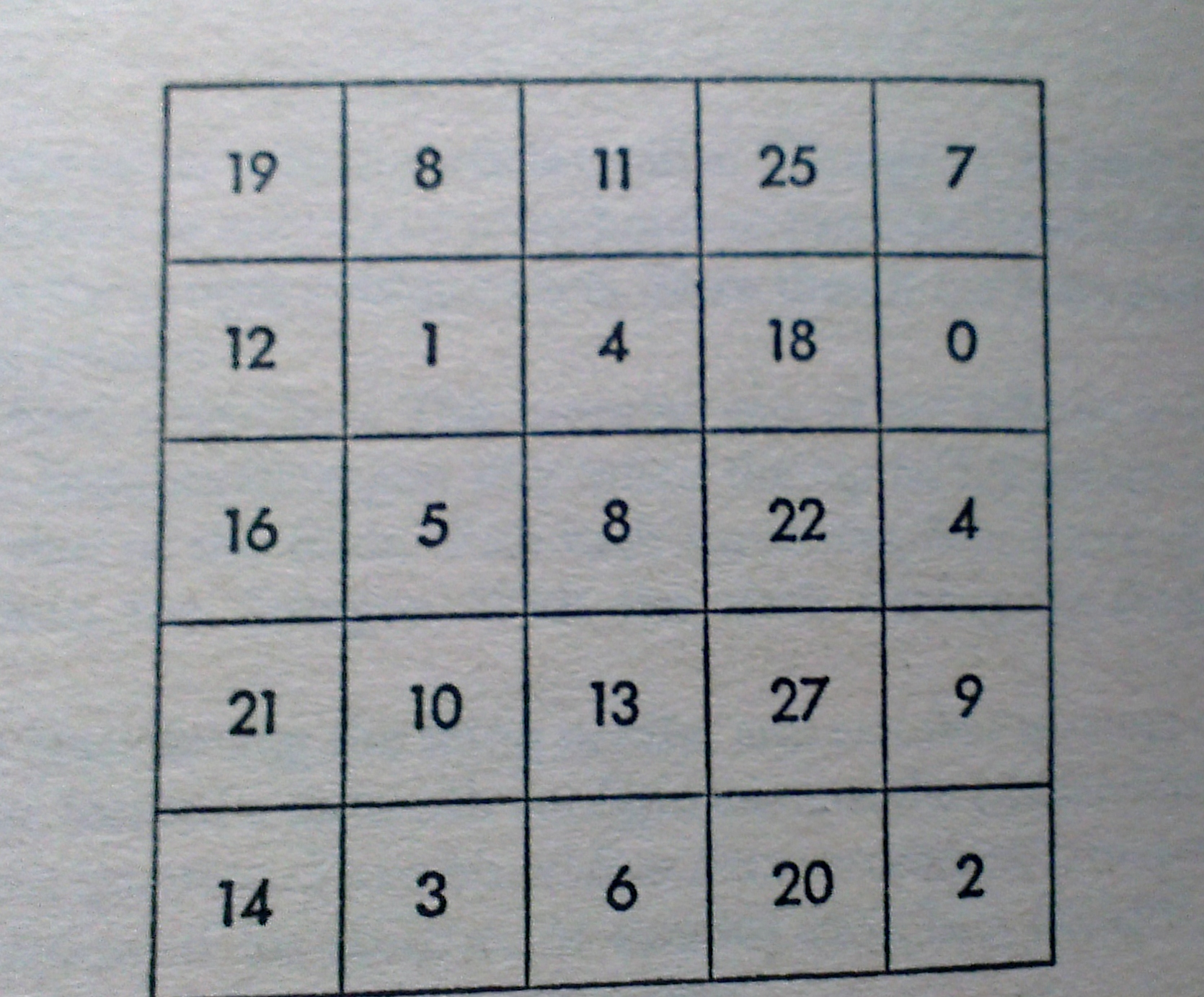
The numbers are arranged such that if you take any 2×2 sub square, the sum of the numbers on the diagonals of the 2×2 sub square are equal. As a direct consequence of this, the sum of the numbers on the  diagonals of any 3×3 or 4×4 or 5×5 sub square are also equal.

When you follow the process of putting coins and eliminating squares in the column and row, you are essentially selecting numbers that can only be on a diagonal relative to each other.


You can reconstruct another such 5×5 square starting with any arbitrary numbers and adding up to any arbitrary number , including 57.


example:

start with a 2×2, sum of diagonals is 5


3 4

1 2


add numbers to make it 3×3, sum of diagonals is 14


3 4 7

1 2 5

5 6 9


add squares to make it 4×4, sum of diagonals is 30


3  4  7 10

1  2  5  8

5  6  9 12

9 10 13 16


add squares to make it 5×5 sum of diagonal is 57


3  4  7 10 14

1  2  5  8 12

5  6  9 12 16

9 10 13 16 20

16 17 20 23 27


You can also go from 4×4 to 5×5 and make the sum of diagonals equal to say, 40


3  4  7 10  6

1  2  5  8  4

5  6  9 12  8

9 10 13 16 12

7  8 11 14 10


Posted in Solution | Tagged , , , | Leave a comment

Puzzle #23: Yet Another Magic Square

I came across this rather interesting “magical” square – let’s see if you can figure out the trick behind this. This is good for all ages.

In general, magic square refers to a grid of numbers where each row, column and diagonal adds up to the same number. Let’s see a square of a completely different kind. Have a look at the square below:

Magic Square

Magic Square

At first glance, the square does not appear to have any special property. However, do the following experiment. Ask someone to pick any number and cover it with a coin. Eliminate all the numbers in the row and column where the coin has been placed (except the number below the coin). Now select any other number from the ones that still remain, and do exactly what you did before. Repeat this two more times. Only one number should remain on the square now, cover it with the fifth coin.

Remove the coins and add all the five numbers. You will find that no matter which numbers you had selected, the addition is always 57. Can you figure out why?

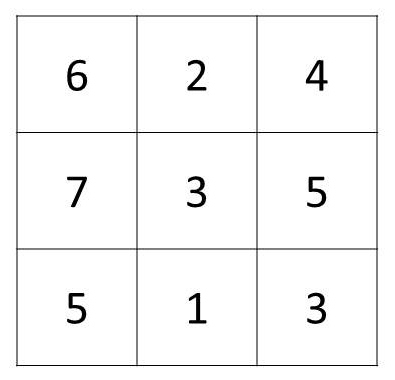
For younger children, try playing this game with the following square:

Magic Square for Younger Children (<10 years)

Magic Square for Younger Children

You will notice that no matter which ones you select, sum is always 12!

Enjoy figuring out!

Posted in Puzzles | Tagged , , | Leave a comment

Solution to Puzzle #22: Cutting the Cube

Many people came back with correct answers to the puzzle, though I was disappointed that only adults attempted it, I wish that some of you had shared this with your children! Congratulations again to Ruchir Godura in being the first one to solve it – he sent the answer to me almost immediately after I sent the puzzle, I need to think of better ones for him 🙂

The answer to the puzzle is that the carpenter will need a minimum of six cuts. When I first tried the puzzle, I tried pretty hard to do this in five cuts, and to my dismay, there would always be one or two larger blocks left that needed a cut.

The logic, like all good puzzles, is very simple. If you think about the 27 smaller cubes, there is a cube at the center. This smaller cube has 6 faces – each of which requires a cut and is either parallel or perpendicular to each other, and hence requires a separate cut through the buzz saw. Therefore a minimum of 6 cuts are required.

Hope you enjoyed the puzzle!

Posted in Solution | Tagged , , | Leave a comment

Puzzle #22: Cutting the Cube

This is a puzzle picked up from one of Martin Gardner collections. Might be just a touch difficult for kids, but worth trying.

A carpenter, working with a buzz saw, wishes to cut a wooden cube, three inches on a side, into 27 one-inch cubes.  He can do this job easily by making six cuts through the cube, keeping the pieces together in the cube shape.  Can he reduce the number of necessary cuts by rearranging the pieces after each cut?  Either show how or prove that it’s impossible.

Happy solving!

Posted in Puzzles | Tagged , , | 1 Comment

Solution to Puzzle #21: Stuck on the Roof

Apologies for the delayed posting of the solution – I was on vacation on both of the previous weekends, traveling outside the country.

As I mentioned in the puzzle, this was a lateral thinking puzzle. The first person to answer this puzzle was Ruchir Godura – who answered this within a few minutes probably!

Here is the solution – Rajeev uses the knife to cut the rope at 50M length. He make a loop at one end and ties the other one to the hook. Through this loop, he takes the remaining 100M rope and then ties both the end of the 100M rope. This way he has a rope of 100M (50M shorter one, and a double rope of 50M hanging through the loop of the smaller one) to come down to the ledge. One he reaches the ledge, he can pull the longer rope until he finds the knot, unties it, and now he has a 100M rope with which he can come down. Answer is also explained in the video on this link:

Hope you enjoyed this.

Posted in Solution | Tagged , , , | Leave a comment

Puzzle #21: Stuck on the Roof (A Lateral thinking problem)…

This is a very nice lateral thinking problem I picked up from this wonderful collection of puzzles (http://gurmeet.net/puzzles/).

Rajeev is trapped atop a building 200m high. He has with him a rope 150m long. There is a hook at the top where he stands. Looking down, he notices that midway between him and the ground, at a height of 100m, there is a ledge with another hook. In his pocket lies a Swiss knife. Hmm… how might he be able to come down using the rope, the two hooks and the Swiss knife?

As always, please send me answers directly at alokgoyal_2001@yahoo.com

Happy escaping!

Posted in Puzzles | Tagged , , | Leave a comment