Solution to Puzzle #15: The Early Commuter

I liked this puzzle because there is a seeming lack of data. When I came across this puzzle in February this year, I kept getting lost in too many variables! I got many correct answers and more comments than for any other puzzle to date. As in many cases, special mention for Tishyaa for having completed this puzzle correctly – sorry not mentioning all the adults who solved the problem!

Here is the answer – 55 minutes.

Since the couple arrives home 10 minutes earlier than usual, this means that the wife has chopped 10 minutes from her usual travel time to and from the station. Which means she chopped 5 minutes from her travel time to the station, which also means that she must have met her husband at 4.55 pm. Therefore, her husband must have walked for 55 minutes.

Note that one does not need to know the distance from home to the station, or the speed at which the wife drives the car or the speed at which the man walks.

Hope you enjoyed!


Posted in Solution | Tagged , , | Leave a comment

Puzzle #15: The Early Commuter

A commuter is in the habit of arriving at his suburban station each evening at exactly five o’clock.  His wife always meets the train and drives him home.  One day he takes an earlier train and arrives at his station at four o’clock.  The weather is pleasant so instead of telephoning home, he starts walking along the route always taken by his wife.  They meet somewhere along the way. 

He gets into the car and they drive home arriving ten minutes earlier than they usually do.  Assuming that the wife always drives with a constant speed, and on this particular occasion she left just in time to meet the five o’clock train, can you determine how long the husband walked before he was picked up?

Source: My Best Mathematical and Logic Puzzles, by Martin Gardner; Puzzle #8

Target Ages: All ages

Posted in Puzzles | Tagged , , | 12 Comments

Solution to Puzzle #14: Measuring Time

I got a lot of correct answers for this puzzle, and very happy to see this. Since the puzzle does not require any graphic for explaining the solution, I will just put the answer in text this time.

Answer for the second one: The trick here is to realize that you can measure 4 minutes by starting the two timers together and when the 7 minutes timer goes off, from that moment onwards until the 11 minute timer goes off, you have an interval of exactly 4 minutes. Once you are able to do that, you can use the 11 minutes timer again to reach 15 minutes. Therefore the answer is as follows:

(1) Start both timers together, (2) When the 7 minutes timer goes off, start boiling the egg, (3) Start the 11 minute timer again when it goes off, you have measured exactly 15 minutes

Answer to the First One: This is clearly trickier, though many people posted the answer correctly. There are two tricks to this puzzle: (1) Even though half the length of a fuse does not mean half the time to burn, if you light a fuse at both ends, the two sides will meet at exactly half the time, (2) You can light both the fuses also at the same time. Combining these two, here is the asnwer

(1) Light both sides of fuse #1, and one side of fuse #2

(2) When the two sides of fuse #1 meet, then 30 minutes have elapsed. At that time, light the other side of Fuse #2 as well

(3) Since 30 minutes were remaining in fuse #2 at the time fuse #1 fully burnt, it will take another 15 minutes for it to fully burn since it has now both sides lighted and you get 45 minutes.

Hope you enjoyed this!


Posted in Solution | Tagged , , , | Leave a comment

Puzzle #14: Measuring Time

In this “episode”, there are two different puzzles, both of them are measuring a specific duration of time with a few “timers”.

Here is the first one:

You have two lengths of fuse, each will burn for exactly one hour. But the fuses are not necessarily identical and do not burn at a constant rate. There are fast burning sections and there are slow burning sections. How do you measure 45 minutes using the fuses and a lighter?

Source: How Would you move Mount Fuji, by William Poundstone; Puzzle #50

Target: 12+ years

Here is the second one:

You have two timers, one that goes off after 7 minutes and another one that goes off after 11 minutes. You need to boil an egg for exactly 15 minutes. How would you measure 15 minutes using the two timers?

Source: Mathematical Cirlces (Russian Experience) by Dmitri Fomin, Sergey Genkin and Ilia Itenberg (Page 67, Puzzle #18)

Target: 8+ year

Posted in Puzzles | Tagged , , | 3 Comments

Solution to Puzzle #13: Mutilated Chessboard and Dominoes

I got two correct answers to this puzzle, though I believe many people have done this puzzle in the past. The correct ones were from Tishyaa Chaudhry and Anisha Sharma Goyal – congratulations to both!

The trick to the puzzle is as follows: Every domino can cover one white and one black square, there is no way to cover two whites or two blacks. Once you establish this, you will realize that the two opposite corners are of the same color, and hence if you remove two whites, there is no way to cover an unequal number of white and black squares on a chessboard.

Solution to the puzzle is also on the following link:

Hope you enjoyed the puzzle!

Posted in Puzzles | Tagged , , | Leave a comment

Puzzle #13: Mutilated Chessboard and Dominoes

This is a famous puzzle that I have come across in many different puzzle books. I have taken this from one of Martin Gardner’s books – The Best Mathematical and Logic Puzzles (Puzzle #3).

The props for this puzzle are a chessboard and 32 dominoes. Each domino is of such size that it exactly covers two adjacent squares on the board. The 32 dominoes therefore can cover all 64 of the chessboard squares. But now suppose we cut off 2 squares at diagonally opposite corners of the chessboard (see graphic below) and discard one of the dominoes as well, i.e. we have 31 dominoes now. Is it possible to cover the 62 squares on the board with the 31 dominoes? If so, show how, and if not, prove that it is impossible?

Puzzle 13 graphic

Note for parents: Show a domino if your child has not seen one. Also, for kids younger than 10, try doing it with a 4×4 chessboard first.

Posted in Puzzles | Tagged , , | Leave a comment

Solution to Puzzle #12: How many routes?

I got only two correct answers for this puzzle – one of which is from Tishyaa Chaudhry, who is one of the most amazing puzzlers amongst kids I have come across. Well done Tishyaa.

There are two good solutions to the puzzle, one of which requires the knowledge of Combinatorics. I have outlined both the solutions in the link here:

Hope you enjoyed this one.

Posted in Puzzles | Tagged , , , | Leave a comment

Puzzle #12: How Many Routes?

This is a puzzle from the book “Moscow Puzzles”, and the book borrowed this puzzle from one of the Mathematical Circles, a unique Russian way of making learning of Mathematics more fun through puzzles.

Here is the puzzle:

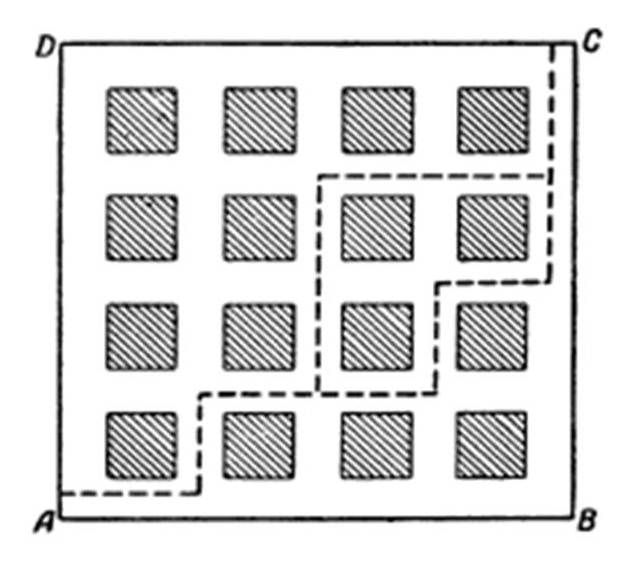
How many different routes can we draw from Point A to Point C, moving only upwards and to the right? Different routes, of course, may have portions that coincide, as in the figure.

Puzzle 12 graphic

Suggestion: For children below 12 years of age, try the same question with a 3×3 grid instead of a 4×4 grid; For below 8 years, try it with a 2×2 grid.

There are some very neat solutions to this, so please try!

P.S.: Please do not post the solutions in your comments, I am forced to keep these comments in “cold storage” until I post the solutions. You can write the answers to me directly at alokgoyal_2001@yahoo.com


Posted in Puzzles | Tagged , , | Leave a comment

Solution to Puzzle #11: The 10-digit number

I got the most number of correct answers for this puzzle. I was particularly impressed by Ameya Kulkarni (from London), Salil Kuchlous (from Bangalore) and Tishya Chaudhry and Anisha Sharma Goyal (both Gurgaon) – all kids who solved the puzzle.

The puzzle had appeared originally in MIT’s Technology Review, which was written by Allan J. Gottlieb, and the solution appeared in the February 1968 issue. The solution is more a trial and error process, with a few rules applied to it. I have recorded the solution as always. If anyone would like to have a more complete proof, I am happy to send it to them – please write to me directly at alokgoyal_2001@yahoo.com.

The correct answer is 6,210,001,000. This is a unique answer for 10 digits. For fewer than 10 digits, the answers are 1210, 2020, 21200, 3211000, 42101000, 521001000.

Thanks for trying the puzzle!


Posted in Puzzles | Tagged , , | Leave a comment

Puzzle #11: The 10-digit number

This is a very nice puzzle I picked up a few days back from one of the Martin Gardner books. I also tried it with my 8 year old, who solved it with some persuasion.

Puzzle 11 Graphic

In the 10 cells of the figure above, inscribe a 10-digit number such that the digit in the first cell indicates the total number of zeros in the entire number, the digit in the cell marked “1” indicates the total number of 1’s in the number, and so on to the last cell, whose digit indicates the total number of 9’s in the number. Zero is a digit, of course. The answer is unique.

For children, ask them to solve the same puzzle with 4 digits and 5 digits first before going on to 10 digits.

Happy puzzling!

Posted in Puzzles | Tagged , , | 19 Comments