Puzzle #161: Lost Car Key Puzzle

This is a very nice probability puzzle, variations of which we have done in the past. This one is contributed by Suman Saraf – Thanks Suman!

I drive to work, and put my car keys in my pocket. Whenever I sit down in a meeting there is a 20% chance that my car keys might fall out of my pocket (unnoticed). At lunchtime, I reach for my keys and find out they are missing. If I’ve had three sit-down meetings that morning, what is the chance that the car keys fell out in the first meeting location?

(You can assume the only place the keys could have fallen out is in one of those three locations)

As always, please send your answers as comments within the blog (preferred), or send an e-mail to alokgoyal_2001@yahoo.com. Please do share the puzzle with others if you like, and please also send puzzles that you have come across that you think I can share in this blog.

Happy driving!


Posted in Puzzles | Tagged , | 1 Comment

Solution to Puzzle #159: Winning Strategy With Coins

This was indeed a beautiful puzzle, thanks again Prateek! Apologies that I could not post anything last weekend, I was traveling.

I got correct answers from Suman Saraf, Pratik Poddar and Shruti Mittal – well done all.

Reproducing the answer from Pratik Poddar here:

“I play first. I place my first coin at the centre of the table. Then the other guy places somewhere. My response is always to place a coin at the exact diamaterical opposite point. Hence I always have a way to put the coin if he has. I win.”

Hope you all enjoyed the puzzle!

Posted in Solution | Tagged , | Leave a comment

Puzzle #160: $50 for All

This is yet another beautiful puzzle from the NSA collection!

At a work picnic, Todd announces a challenge to his coworkers. Bruce and Ava are selected to play first. Todd places $100 on a table and explains the game. Bruce and Ava will each draw a random card from a standard 52-card deck. Each will hold that card to his/her forehead for the other person to see, but neither can see his/her own card. The players may not communicate in any way. Bruce and Ava will each write down a guess for the color of his/her own card, i.e. red or black. If either one of them guesses correctly, they both win $50. If they are both incorrect, they lose. He gives Bruce and Ava five minutes to devise a strategy beforehand by which they can guarantee that they each walk away with the $50.

Bruce and Ava complete their game and Todd announces the second level of the game. He places $200 on the table. He tells four of his coworkers — Emily, Charles, Doug and Fran—that they will play the same game, except this time guessing the suit of their own card, i.e. clubs, hearts, diamonds or spades. Again, Todd has the four players draw cards and place them on their foreheads so that each player can see the other three players’ cards, but not his/her own. Each player writes down a guess for the suit of his/her own card. If at least one of them guesses correctly, they each win $50. There is no communication while the game is in progress, but they have five minutes to devise a strategy beforehand by which they can be guaranteed to walk away with $50 each.

For each level of play – 2 players or 4 players– how can the players ensure that someone in the group always guesses correctly?

As always, please send your answers as comments within the blog (preferred), or send an e-mail to alokgoyal_2001@yahoo.com. Please do share the puzzle with others if you like, and please also send puzzles that you have come across that you think I can share in this blog.

Happy $50!

Posted in Puzzles | Tagged , | 2 Comments

Solution to Puzzle #158: Trees in a Row

This was a simple puzzle, though I did not get as many answers as I would have liked to. That said, I had only done one possible answer, but trust some of the puzzle gurus to send in some really imaginative answers! Sid Mulherkar sent me 3 answers to the puzzle, Amit Mittal sent 2 answers and several people sent the more obvious answers that include Pratik Poddar, Praneeth, Nikhil Kharwandikar and Suman Saraf.

Here are the three possible solutions, I have taken the liberty of taking two of these from Amit Mittal’s response and the 3rd one from Sid Mulherkar.


The most obvious answer was a star. The one drawn by Sid on paper is a really good one that no one else thought of!

Hope you all enjoyed the puzzle!


Posted in Solution | Tagged , | Leave a comment

Puzzle #159:Winning Strategy with Coins

This is a beautiful puzzle contributed by an ex-entrepreneur, Prateek Agarwal, who I met a few weeks back – thanks Prateek.

You and your friend are playing a turn based game. There is a circular table of diameter 10cm and unlimited coins of diameter 1cm. Each player needs to keep the coins on the table such that they don’t overlap. No player can move an already placed coin from its place. If any player is not able to keep the coin on the table in his turn, he loses. Also, players can’t pass their turn. Each of you are playing to win obviously.

Now your friend, being generous, has offered you to play the first turn. Should you play first? If yes, then what should be the strategy? If no, then what should you do. If you choose to not play first, this won’t be considered as passing the turn as the game hasn’t started yet.

Happy Diwali to all readers!

Posted in Puzzles | Tagged , , | 3 Comments

Solution to Puzzle #157: Journey of a Monk

This was a very nice puzzle – not an easy one and as such I received answers from the classical die hards. People who sent the correct answers include Suman Saraf and his daughter (I think age 10!), Sid Mulherkar, Pratik Poddar and Vishal Poddar. Well done all.

Copying answers from Vishal as well as Suman that explain the same thing:

[From Vishal] For both the days, lets draw a graph between his height and time. On day 1, it will start from 0 at 6am and end at h at 8pm. It will be a continuous graph. On day 2, the graph will start from h and go till 0. We can see that there will be a point where both the lines intersect. This is the point where the monk was on both the days at same time.

[From Suman and his daughter] If we mirrored the return journey on another monk on the same day (the original one is walking up), you can see they would cross each other at some point. This is the same point where the monk will have been while come down next day 🙂


This is based on a mathematical theorem known as the Intermediate Value Theorem. Interested reader can read more at https://en.wikipedia.org/wiki/Intermediate_value_theorem.

Hope you enjoyed the puzzle!


Posted in Solution | Tagged , , | Leave a comment

Puzzle #158: Trees in a Row

A very nice riddle contributed by Abhinav Jain, which appeared in Delhi Times. Thanks Abhinav.

A man bought 10 trees from a local nursery.He wants his gardener to plant the 10 trees in 5 rows with 4 trees in each row. How can the gardener complete the task ?

As always, please send your answers as comments within the blog (preferred), or send an e-mail to alokgoyal_2001@yahoo.com. Please do share the puzzle with others if you like, and please also send puzzles that you have come across that you think I can share in this blog.

Happy tree planting!


Posted in Puzzles | Tagged , | 3 Comments

Solution to Puzzle #156: Area of the 8th Block

Thanks Suman again for this lovely puzzle. The usual suspects came back with the right answer – Karan, Sid Mulherkar and Abhinav Jain (and I am not counting Suman or his daughter on this one).

Was a simple puzzle, but looks a bit daunting initially. Here is the answer copied from Sid:

Observe that the sum of the surface areas of one set of mini cuboids which do not share a face but share an edge at least one of the others will equal the sum of the areas of the other set. Let A be the area of the 8th block.

We get 88+58+126+A=148+28+46+72.

This gives A=22.

Hope you all enjoyed the puzzle!


Posted in Solution | Tagged , | Leave a comment

Puzzle #157: The Journey of a Monk

Thanks to Abhinav Jain for this wonderful puzzle!

One morning at 6 am, a monk began climbing a tall mountain, which happened to only have one path to the top. He ascended the path at his leisure, taking some stops along the way. He reached the top at 8 pm.

The next morning at 6 am, the monk descended the mountain along the same path. He took several breaks along the way, and reached the bottom at 8 pm.

The amazing result: there is some spot on the path that the monk occupied at precisely the same time of day for both trips. Why is this?

As always, please send your answers as comments within the blog (preferred), or send an e-mail to alokgoyal_2001@yahoo.com. Please do share the puzzle with others if you like, and please also send puzzles that you have come across that you think I can share in this blog.

Happy mountain climbing!


Posted in Puzzles | Tagged , | 3 Comments

Solution to Puzzle #155: Bugs on a Square

This was an old puzzle, and many of you had done it before. Many people sent the right answer, though many people sent wrong answers as well. Folks who did it correctly included Suman Saraf, Prakhar Prakash, Sid Mulherkar, Vishal Poddar, Abhinav Jain, Prateek Poddar and Amit Mittal. Well done all.

I am reproducing the answer from Sid Mulherkar, who explained it nicely.

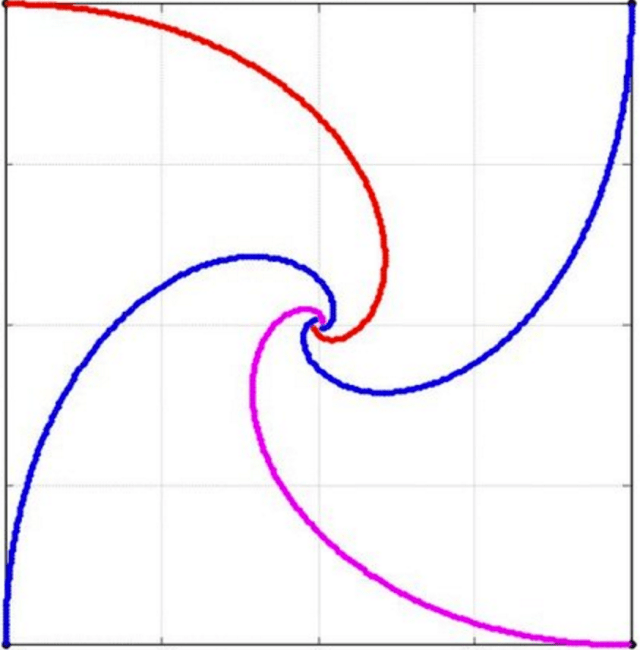
Suppose you are one of the bugs. According to you one bug is directly moving towards you at all times with a constant speed. Since you are moving perpendicular to the bug following you at all times, there is no component of your velocity that is moving towards or away from the bug following you. Hence this means that the time taken for the bugs to meet will be the same as the time taken for one bug to just travel 10 cm (the side of the square). Hence the answer will be 10/v where v is the speed of the bug. A more rigorous solution can be found using calculus, but this also suffices for this problem. I have tried the problem with unsymmetrical shapes(trapezium, rectangle, etc.)..In this I believe calculus is required.

here is also a diagram that shows what the path will be like:

Screenshot 2016-10-16 14.37.09.png

The puzzle can be more tantalizing and require higher level concepts if we convert the shape from a square to a triangle or other shapes (As Sid also pointed out). The interested reader can read more about it at the following link:

Hope you all enjoyed the puzzle!


Posted in Solution | Tagged | Leave a comment