Solution to Puzzle #162: Who Finished 2nd in 100m?

Suman Saraf rightly reminded me that I had not posted the solution for this puzzle. My apologies. Many people did this correctly. Mahi Saraf, Anisha Sharma Goyal, Pratik Poddar, Abhinav Jain and Vishal Poddar all sent correct answers – well done!


Answer is Charlie. Here is the explanation:

First, realize that the total points awarded is 40. Given that we are dealing with integers that means the total number of Events (TE) times the total number of points awarded in an event (TP) must equal 40. We can quickly eliminate some possibilities.

Events (TE) Points (TP)
1 40 Not possible since we know there are at least two events
2 20 Not possible since Adam and Bob both won 1 event. There would be no way for Bob and Charlie to finish with the same points.
4 10 A possibility
5 8 A possibility
8 5 Not possible, since 1st>2nd>3rd>0 means the minimum number of points awarded HAS to be 6 (3, 2, 1)
10 4 Same Reason
20 2 Same Reason
40 1 Same Reason

So we now know it was either 4 events with 10 points awarded in an event or 5 events with 8 points awarded. Let’s look at the 4/10 situation first. The possible points for each place with 10 overall points available is (all other combinations are impossible because of the 1st>2nd>3rd>0 constraint):

  • 5, 3, 2Not possible as there is no way to get to 22 points in 4 events (greatest possible points would be 20)
  • 5, 4, 1Same reason
  • 6, 3, 1Not possible, since no combination of 4 numbers can get to 22 points (3 ×6+3= 21, 4 ×6=24)
  • 7, 2, 1A possibility – let’s look further.

Can we get Adam to 22? Yes. Adam can finish 1st 3 times and 3rd once (in the Javelin). 3 ×7+1 = 22.

Can we get Bob to 9? Nope. Bob won the Javelin (7 points). There’s no way to get to 9 with the remaining event/point combinations. Sooooo …

There must be 5 events with a total of eight points (we’re getting close). Let’s look at the possible points (again, the other combinations are not possible because of the 1st>2nd>3rd>0 constraint):

  • 4, 3, 1Not possible as there is no way to get to 22 points (4 ×5=20 is maximum)
  • 5, 2, 1Looks like this is the winner. Let’s check.

Can we get Adam to 22? Yes. Adam can finish 1st 4 times and 2nd once (4 ×5+2). Since we know Bob finished 1st in the Javelin, Adam must have finished 2nd.

Can we get Bob to 9? Yes. Bob finished 1st in the Javelin (5 points) and finished 3rd 4 times (4 ×1) for a total of 9 points.

Can we get Charlie to 9? Yes. Charlie finished 3rd in the Javelin (1 point) and must have finished 2nd in the 4 other events (4 ×2) for a total of 9 points.

Since Charlie finished 2nd in EVERY EVENT OTHER THAN THE JAVELIN, he MUST have finished 2nd in the 100-meter dash. Here is a little table:

Javelin Event 2 Event 3 Event 4 100m Dash Total
Adam 2nd (2 pts) 1st (5 pts) 1st (5 pts) 1st (5 pts) 1st (5 pts) 22 pts
Bob 1st (5 pts) 3rd (1 pt) 3rd (1 pt) 3rd (1 pt) 3rd (1 pt) 9 pts
Charlie 3rd (1 pt) 2nd (2 pts) 2nd (2 pts) 2nd (2 pts) 2nd (2 pts) 9 pts

Hope you all enjoyed the puzzle!

Posted in Solution | Tagged | Leave a comment

Puzzle #166: Donut Sharing

This puzzle is a variation of a puzzle I had posted very early (amongst my first 10 posts). It is very simple, and intended for children. Thanks to Suman Saraf for contributing this one.

Alice and Bob go into their local donut shop. Alice buys five donuts, and Bob buys three. As they are leaving, they meet Charlie and decide to cut-up, and share, all eight donuts equally between the three of them. After the feast, Charlie reaches into his pocket and discovers he has $0.80 in coins. Even though he knows that this amount of money is less than his share of the donuts eaten, he wants to compensate, as fairly as possible, Alice and Bob.

Question: How much of the money should he give Alice, and how much should he give Bob?

(All the donuts are same price, everyone eats the same amount, and ‘fair’ means repayment of Alice and Bob equal percentages of their own individual outlays)

Happy sharing!

Posted in Puzzles | Tagged , , | 1 Comment

Solution to Puzzle #163: The “Hatke” Puzzle

This was a truly “hatke”or a “wierd” puzzle. Unfortunately as it turned out the answer is not very elegant and not very “correct” either. That said, it was a good exercise to exercise the brain, and I got the best attempt from Suman Saraf. I will nonetheless reproduce what the original creator of the puzzle had intended.

It unifies the three conventional functions of reasoning: verbal, numerical and spatial. The solution is a single English word.
The operators work as follows –
: : = “is to”
:: = “as”
Ex. a : b :: 1 : 2
Verbal Associations are solved by finding the term or word to unify the given clues.
Ex. Row, Float, Sail = Boat
On the left hand side, once can see that the two triangle figures are merged and multiplied. Similarly, the two colors are merged as well and the lower letters multiplied:
f – stands for 6
h – stands for 8
multiplied – we get 48 modulo 26, we get 22, which stands for “v”
Right had side –  Inertia and Critical signify “Mass”
and,
Change and Momentum signify “Acceleration”
Mass x Acceleration = FORCE

Force is therefore the final answer!

Hope you enjoyed the puzzle!

Posted in Solution | Tagged , | Leave a comment

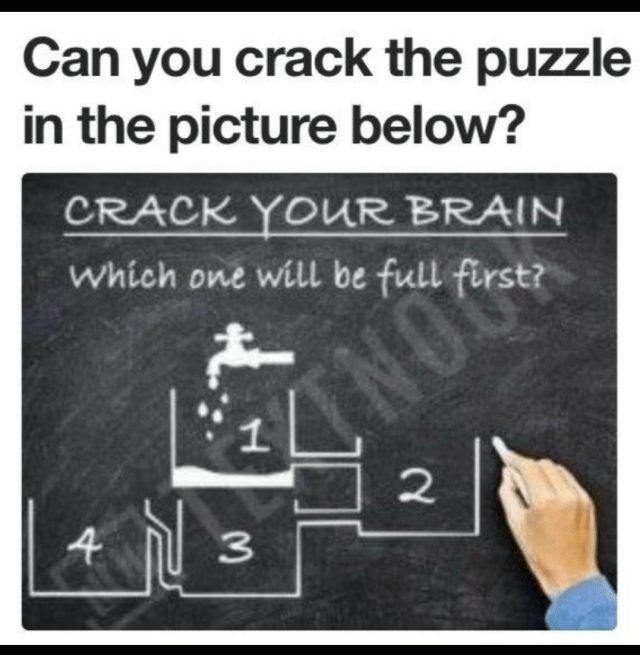
Solution to Puzzle #164: The Physics Puzzle

I am posting the solution for Puzzle #164 before I do so for puzzle #163, which I will do next week. It was not too difficult a puzzle, and even if you did not try it with your children, please do so again, it will be fun. Thanks to many of you for correct answers – Pratik Poddar, Vishal Poddar, Prakhar and Sid Mulherkar. For a change, I also did the puzzle correctly 🙂

The answer is that 3&4 will be full together. Lets see it with the help of the following diagrams (entire answer copied from quora at https://www.quora.com/Which-pot-will-be-full-first?srid=3F2V&share=3bc98cec

It is simple Fluid Dynamics. Let’s do it on Paper assuming ideal condition. Keep imagining to understand.

  1. We have 1 water outlet & 4 tanks connected to each other as shown in picture.

2. Open valve, Tank-1 will be filled as shown below.

3. Now T1 level_constant & T2 level_increase

4. T1,T2 level_constant & T3 level_increase

5. T1, T2 level_constant & T3 level is increasing.

6.

7. Now water will flow to T4.

T1, T2, T3 level_constant & T4 level_increase.

8. T1, T2, T3 level_constant & T4 level is increasing.

9. T3 = T4.

10. Now T2, T3, T4 level increase with same value.

11. T3 & T4 is completely filled.

Infinite condition all tank level constant. Water given to T1 will be totally spill out by T3 & T4.

*Ideal condition means all tanks & pipe connection are same, Room temperature-pressure, Fluid used water, No any type of losses, water flow at constant pressure-value, and “neglecting your high intelligence :P”

Hope you all enjoyed the puzzle.

Posted in Solution | Tagged , | Leave a comment

Puzzle #165: Truth & Lies – 7 of them!

Welcome back, and a very happy new year to all of you. Lets start with a new puzzle before I post solutions to previous problems. I will begin this week with a very nice puzzle from the NSA collection.

Here it goes:

The chief detective hurried down to the police station after hearing big news: there was a heist at Pi National Bank! The police had brought in seven known gang members seen leaving the scene of the crime. They belonged to the nefarious True/False Gang, so named because each member is either required to always tell the truth or required to always lie, although everyone is capable of engaging in wrongdoing. The chief also knew from his past cases that any crime committed by the gang always included one truth teller.

When the chief showed up, he asked the gang members the following questions:

  • 1) Are you guilty?
  • 2) How many of the seven of you are guilty?
  • 3) How many of the seven of you tell the truth?

Here were their responses:

  • Person 1: Yes; 1; 1
  • Person 2: Yes; 3; 3
  • Person 3: No; 2; 2
  • Person 4: No; 4; 1
  • Person 5: No; 3; 3
  • Person 6: No; 3; 3
  • Person 7: Yes; 2; 2

After looking these answers over, the chief prepared to arrest those responsible.

Which of these seven did the chief arrest?

As always, please send your answers as comments within the blog (preferred), or send an e-mail to alokgoyal_2001@yahoo.com. Please do share the puzzle with others if you like, and please also send puzzles that you have come across that you think I can share in this blog.

Happy policing!

Posted in Puzzles | Tagged , , | 3 Comments

Puzzle $164: The Physics Puzzle

Here is the second one for today, and something to keep you all occupied in the holidays, even though I know you all will have better things to do like beach, snow, ….

This one is contributed by Suman Saraf, a very intriguing puzzle and the answer is not as easy as it looks in the first look.

screenshot_2016-10-26-20-03-53-543_com-quora-android-1

Puzzle #164 Graphic

As always, please send your answers as comments within the blog (preferred), or send an e-mail to alokgoyal_2001@yahoo.com. Please do share the puzzle with others if you like, and please also send puzzles that you have come across that you think I can share in this blog.

Happy drinking, and happy holidays, will be back in Jan now!


Posted in Puzzles | Tagged , | 5 Comments

Puzzle #163: The “Hatke” Puzzle

Friends, I am going to be traveling/ on vacation over the next few weekends and hence taking the liberty of posting two puzzles this weekend, and restart in the weekend of Jan 6th.

This one is a very “hatke” (in hindi, which means very different) kind of puzzle. I personally cannot figure out a head or tail of it, but it comes from a credible source and hence posting it. I do not know the solution myself. This was contributed by my nephew, Karan Sharma, who is one of the regulars on this blog.

Figure out the ? in the figure below.

Puzzle #163: Figure out the "?"

Puzzle #163: Figure out the “?”

As always, please send your answers as comments within the blog (preferred), or send an e-mail to alokgoyal_2001@yahoo.com. Please do share the puzzle with others if you like, and please also send puzzles that you have come across that you think I can share in this blog.

Happy scratching your head on this one!

Posted in Puzzles | Tagged , | Leave a comment

Solution to Puzzle #161: Lost Car Key Puzzle

Apologies for not posting the answer last weekend, I was traveling again 🙂

I guess conditional probability puzzles are not the most popular, I got correct answers only from Suman Saraf and Pratik Poddar, even though I thought that the problem was an easy one.

This was a classical conditional probability puzzle. The answer is ~41%

Here is the way to do it:

Probability of losing the key in the first meeting is 20%

Probability of losing the key in the second meeting is 80% x 20% = 16%

Probability of losing the key in the third meeting is 80% x 80% x 20% = 12.8%

Given that we know that the key was lost, it must be in one of the three meetings, and we need to figure out the relative probability of losing in the first meeting vis-a-vis the two others, which can be calculated as:

20%/ (20%+16%+12.8%) = ~41%

Hope you all enjoyed the puzzle!


Posted in Solution | Tagged , | Leave a comment

Puzzle #162: Who finished 2nd in 100m?

Very nice puzzle from the NSA collection. We have seen versions of this in the past, I loved this one as well.

Three athletes (and only three athletes) participate in a series of track and field events. Points are awarded for 1st, 2nd, and 3rd place in each event (the same points for each event, i.e. 1st always gets “x” points, 2nd always gets “y” points, 3rd always gets “z” points), with x > y > z > 0, and all point values being integers.

The athletes are named Adam, Bob, and Charlie.

  • Adam finished first overall with 22 points
  • Bob won the Javelin event and finished with 9 points overall.
  • Charlie also finished with 9 points overall.

Question: Who finished second in the 100-meter dash (and why)?

As always, please send your answers as comments within the blog (preferred), or send an e-mail to alokgoyal_2001@yahoo.com. Please do share the puzzle with others if you like, and please also send puzzles that you have come across that you think I can share in this blog.

Happy running!

Posted in Puzzles | Tagged , | 3 Comments

Solution to Puzzle #160: $50 for All

This was a tough puzzle, and only two people sent correct answers – Suman Saraf (and his daughter) and Pratik Poddar – hats off to both of you!

I am copying the answer from the original source:

The 2-person case is simpler. Let r denote a red card and b denote a black card. Let’s list Bruce’s card’s color first. Then the 4 distinct possibilities are rr, bb, rb, and br. The following strategy is foolproof. Bruce guesses that his card is the same color as Ava’s (covering the cases rr and bb). Ava takes the opposite approach and assumes that her card’s color is different from Bruce’s (covering the cases rb and br). One of them will necessarily be correct. If Bruce and Ava properly employ these strategies, they cannot lose the game.

Before diving into the 4-person case, let’s reexamine the 2-person case. We could interpret a red card as a 0 and a black card as a 1. Then Bruce’s strategy, as described above, handles the cases 00 and 11. His strategy could be interpreted as “the sum of our cards is even.” (0+0=0, 1+1=2) In this language, Ava’s strategy would be “the sum of our cards is odd.” Again, one of them must be right, no matter the cards. Note that Bruce and Ava have divided the sample space of all possible outcomes into 2 cases, based on the sum of the cards.

The 4-person case is more general and depends upon the notion of modular arithmetic, and in particular remainders when dividing by 4. Rather than purely guessing “the suits are the same,” or “the suits are different,” the players must be more clever. Let’s map each suit to a number. Clubs are 0, diamonds are 1, hearts are 2, and spades are 3. So, if Emily looks out and sees hearts (Charles), hearts (Doug), and spades (Fran), she interprets this as 2+2+3=7. Suppose that Emily’s card’s suit is clubs, which she obviously doesn’t know. Consider the following strategies:

  • Emily guesses her suit so that the total sum is a multiple of 4. She sees hearts, hearts, spades and guesses diamonds (2+2+3+1=8).
  • Charles guesses his suit so that the total sum is 1 more than a multiple of 4. He sees clubs, hearts, spades and guesses clubs (0+2+3+0=5).
  • Doug guesses his suit so that the total sum is 2 more than a multiple of 4. He sees clubs, hearts, spades and guesses diamonds (0+2+3+1=6).
  • Fran guesses her suit so that the total sum is 3 more than a multiple of 4. She sees clubs, hearts, hearts and guesses spades (0+2+2+3=7).

In this example, Fran guesses correctly because the total sum is 7, which is 3 more than a multiple of 4. For any combination of suits, one of them must be right. After all, the total sum must be a whole number. And all whole numbers have remainder 0, 1, 2, or 3 when divided by 4. As long as each of them sticks to his/her strategy, the group can ensure they won’t lose the game. Interestingly, it doesn’t matter which numbers they choose to use, as long as they all have different remainders when divided by 4. So, choosing any four consecutive whole numbers is a sufficient mapping.

Hope you all enjoyed the puzzle!


Posted in Solution | Tagged , | Leave a comment